What It Takes to Reach Advanced Spanish
Two years after her first interview, Morgan shares what took her from intermediate to advanced Spanish, what's still hard, and what she'd tell you.
WorldsAcross team · November 14, 2026
In this article · 8 sections
"I'm intermediate. I can get by. So what actually gets you from here to advanced?"
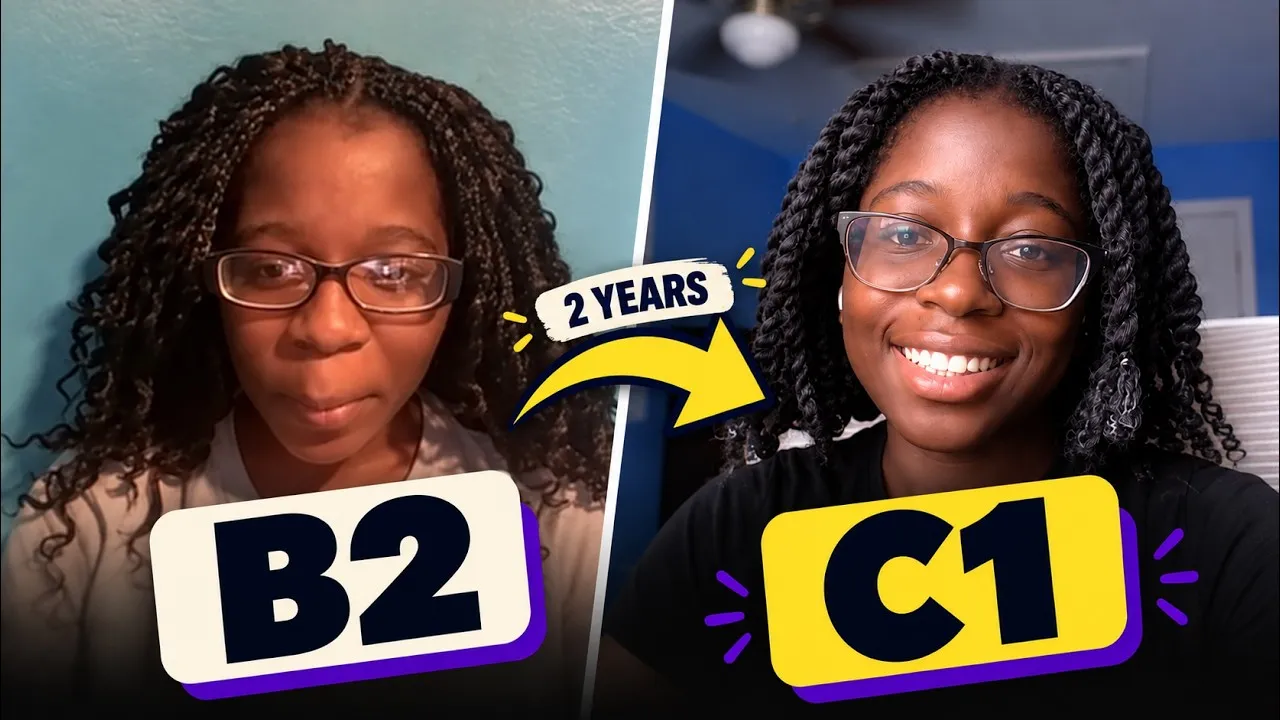
Morgan knows that question from the inside. Almost two years ago she sat down with our host for her first WorldsAcross Story. Back then, she had started learning out of boredom during the pandemic, and her goal for her classes was simple: more confidence when talking with people.
In part two, she's back. And the first thing our host noticed was how she sounds now: more confident, more natural, more relaxed. Here's what she did in between, what's still hard, and what she'd tell you.
The goal she reached: confidence
When Morgan started her classes, the point was to feel more sure of herself when speaking. After a lot of time talking with people, in class and outside it, on the street, at the supermarket, in Spanish-speaking countries, she says she has muchísima más confianza, so much more confidence.
And she says it plainly: Logré eso. I achieved that.
That's worth a second look, because Morgan also describes herself as very introverted. Her real-life Spanish is mostly small talk. If someone she's talking to is struggling in English, she switches to Spanish so they can keep the conversation going. Is the switch automatic? For everyday things, yes. For anything more technical, she still has to think a little more. That's honest, and it's normal.
Our host had a word for how she sounds now, from Argentina: canchero, relaxed and sure of yourself, like you own it.
What changed: from understanding to feeling it
How does she know she's improved? Her yardstick moved. At first, progress meant understanding content without English subtitles. Now, two years or more in, it's about how she feels when she talks with people. It's a feeling inside, she says. Less anxiety. Less nerves.
That's a useful shift to notice in yourself. At the intermediate stage, "can I understand this?" is the question. Closer to advanced, the question becomes "how do I feel when I speak?"
What she did between intermediate and advanced
No secret method. A lot of hours, and a few habits she kept on purpose:
- Conversation, over and over. She puts it down to the hours of practice, more than anything.
- Repeating what she hears. When she watches shows or listens to podcasts, she sometimes repeats lines out loud to imitate accents and pronunciation. She does it less than before, but still does it, and it helps.
- Telenovelas, forever. No los puedo dejar. I can't give them up. She expects they'll be part of her life for good.
- Wider content. Music she didn't listen to before, like rancheras and salsa. Travel vlogs and lifestyle vlogs on YouTube, from creators like Luisito Comunica.
- Reading. Short stories, including some by Gabriel García Márquez.
- Her phone in Spanish. Small, but it's there every day.
The reading part has a good lesson in it. Many learners stay with children's books because they feel safe. Morgan started there too, and got bored fast. When she joined a reading club, she read whatever the group recommended. She didn't understand everything at first, but she understood enough to follow the context of the story. And that was fine. From there, her own interest pulled in more books, little by little.
So don't wait until you understand every word. Ask yourself instead: can I follow the story? If yes, that book is your level.
The hardest part
Morgan didn't pretend the road is smooth. A few things are still hard for her, and you might recognize them.
The plateau doesn't fully go away
Does she still have those moments where she can't see her progress? Yes. She calls it part of the path, for everyone. Her answer is just to keep going:
Sé que lo que debo hacer es seguir adelante. I know what I have to do is keep going.
Keep practicing, keep having conversations, so her Spanish doesn't get rusty. Our host added something worth hearing: the further you go, the harder it is to feel your progress. That doesn't mean it stopped.
Switching back to an English world
Outside her home, everything she sees is in English. After a class, she's still thinking in Spanish, and then she has to go back to work in an English-speaking world. That bothers her sometimes. You lose the rhythm.
Comedy
She watched a clip of the Mexican version of The Office and could feel the same awkwardness as the American one. She understood the words of the jokes. The meaning behind them? Not so much. Comedy is tied to culture, and she's still learning that part. Our host agreed: even for him, Argentine comedy and Venezuelan comedy aren't the same thing.
Sounding like herself
Is there a different Morgan in Spanish? A little less expressive, she says. Some English phrases she uses all the time are part of her personality, and they don't translate well. Our host's suggestion: look for Spanish phrases that carry the same feeling, not the same words. Apart from vocabulary, she thinks her character is pretty much the same in both languages.
She also still works on gender and the subjunctive. If you're advanced and still tripping on small things, you're in good company: see why advanced learners don't know some basic words.
Her tutors, and whose accent
Morgan's favorite tutors right now: Lilian, who has a big personality and has taught her a lot about Peruvian culture. Mauricio, because she leaves every class with him feeling smarter, and he's very funny. And Leticia, whose classes are so fun she always ends up laughing too.
What about accent? She started out focused on Mexican Spanish, because of a Mexican friend and the telenovelas she was watching. Now she's exposed to so many cultures that she doesn't have one fixed place in mind. Our host said she sounds pretty neutral to him. Neither is wrong. Pick what fits your life, and let it change.
A word she loves: vaina
Her favorite word right now is vaina. She heard it a long time ago. She knows what it means. But she's only now starting to feel it.
Our host, who is Venezuelan, called it very Venezuelan, and said vaina isn't just a word, it's a feeling. It can mean a thing, a situation, a mess, whatever you need:
- ¡Qué vaina! What a thing! (good or bad, the tone decides)
- Qué vaina tan buena. What a great thing.
- Qué vaina tan mala. What a bad deal.
- Qué vaina tan loca. What a crazy thing.
Isn't that the advanced level in one word? Not knowing the definition. Feeling it.
What she'd tell you
Does Morgan have a goal, a level where she'll stop? Not right now:
Solo quiero seguir practicando, puliendo mi español. I just want to keep practicing, polishing my Spanish.
Our host put it this way: at this point it's almost a lifestyle. Morgan in Spanish exists, and that's that. (Next up for her, she says: French, starting next year.)
If you're trying to figure out where you stand, read how do I know if I'm already at an advanced level? This story doesn't give you a test. It gives you one learner's path from "I can get by" to "I own it."
Your turn
Pick one line from a show or podcast you love today, and repeat it out loud three times, copying the accent. Then ask yourself Morgan's question: how did I feel saying it?
Watch the full interview on the WorldsAcross YouTube channel.