
Aquí vs. Acá in Spanish: What's the Difference?
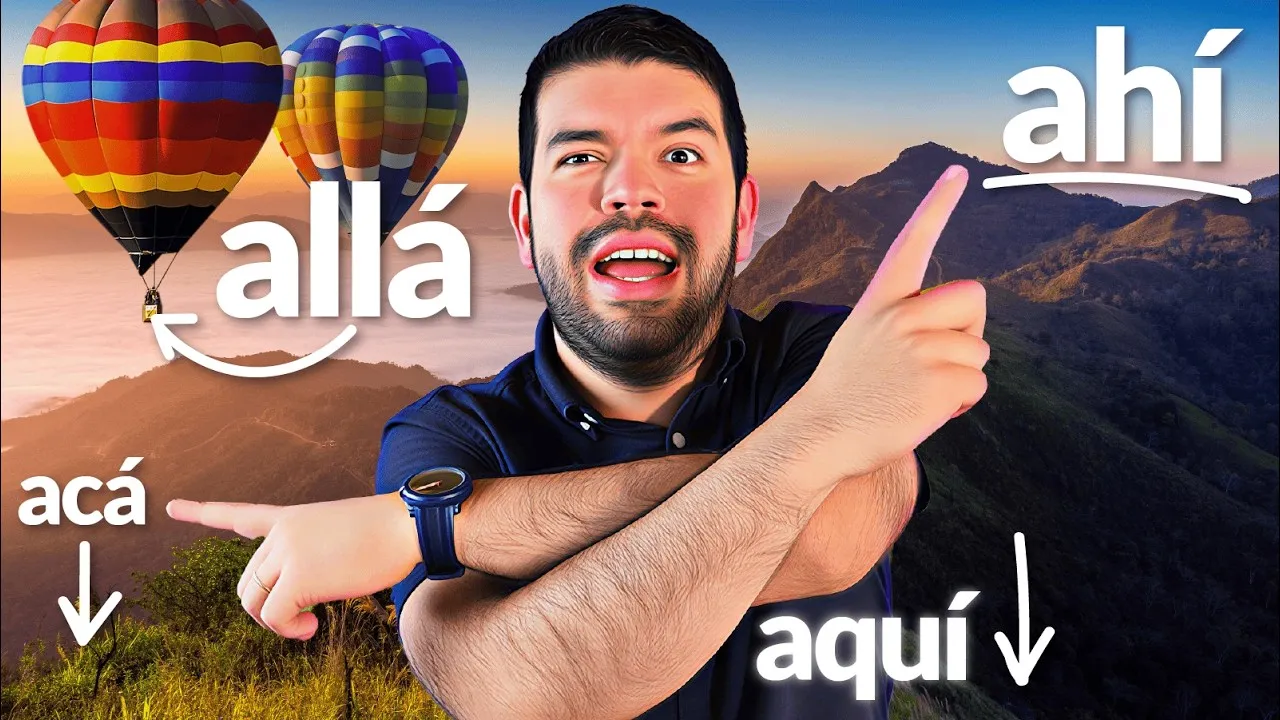
Aquí is right here, acá is around here, ahí is near you and allá is far from both of us. One question tells you which word to use.
WorldsAcross team · November 13, 2026
In this article · 9 sections
La cámara está aquí. Acá en Argentina tomamos mucho mate. La puerta está ahí. Mi amigo vive allá, en Canadá. Four little words, and English covers all of them with just two: here and there.
So if aquí is here and ahí is there, what are acá and allá doing? Same words, different accent? Do you really need all four? Pay attention here, because the answer is simpler than it looks.
By the end of this lesson, you'll have one picture in your head that sorts all four: a line that starts at you and moves a little farther away with each word.
The question to ask yourself
English cares about two things: near me, or not near me. Spanish sees more distances than that. So don't memorize aquí = here. Ask yourself: how far is this from me, and from the person I'm talking to?
Imagine you're standing at one end of a line. Each word takes one step away from you:
- aquí: right here, next to me
- acá: around here, my general area
- ahí: there, near you (the listener), or a medium distance away
- allá: over there, far from both of us
That's the whole map. Now let's walk it.
Aquí: right here, with me
Aquí is for things close to you, the speaker. Usually you can touch them or point at them.
- La cámara está aquí. The camera is here.
- Mis llaves están aquí, en mi bolsillo. My keys are here, in my pocket.
Easy, right? But here's the trick: it's all about perspective. Imagine you live in Chile and you're on the phone with a friend in Spain. You can say:
- Aquí en Chile son las diez de la noche. Here in Chile, it's ten at night.
- Aquí en la Tierra todos necesitamos café. Here on Earth, we all need coffee.
Chile isn't in your hand. The planet definitely isn't. But from where you stand, that's your "here." Aquí stretches as far as your "here" goes. Keep that in mind, because it opens the door to the next word.
Acá: around here
Acá works almost like aquí, especially in that second, bigger kind of here. It points to a general area, not a precise spot.
- Llueve mucho por acá. It rains a lot around here.
- Acá en Argentina tomamos mucho mate. Here in Argentina, we drink a lot of mate.
Notice: llueve mucho por acá doesn't mean it's raining inside your office. That would be weird. It means this part of the city, this region. In the second sentence, acá is the whole country. (Mate is a kind of tea, by the way. Very popular there. You should try it.)
Now, an honest note. Acá is much more common in Latin America than in Spain. In Argentina you'll hear it all day, even for things right next to you. In Spain, people mostly say aquí. These aren't two perfectly separated boxes, and neither one is wrong. If you're unsure, aquí works everywhere.
Ahí: there, near you
Now we flip the coin. Aquí and acá were about the speaker. Ahí is about the listener, the person you're talking to, or anything a medium distance away.
- La puerta está ahí, a tu lado. The door is there, next to you.
- ¿Tu teléfono está ahí? Is your phone there with you?
Look at the first one. You could point at the door. It's not far, but it's closer to the other person than to you. La puerta está aquí, a tu lado would sound strange. "Here, next to you"? You're over there. It's a contradiction.
Here's a bonus: ahí can also point at a place that isn't really a place.
- Ahí está el problema. That's where the problem is.
Nobody's talking about a hole in the road. Ahí points at an idea, the spot in the conversation where things go wrong.
Ojo (watch out): ahí sounds almost identical to hay (there is) and ay (ouch, oh). This is where many learners get stuck when they write. If that's you, read Ay, ahí, allí and hay next.
Allá: over there, far from both of us
Allá sounds a bit like ahí, but it's a different thing. It's for things far from you and from the person you're talking to.
- Mi café está allá, en la cocina. My coffee is over there, in the kitchen.
- Mi amigo vive allá, en Canadá. My friend lives over there, in Canada.
The kitchen is another room. Not aquí, not ahí. Farther. (And yes, the coffee is always in the wrong room.) Canada is the same word on a bigger scale, a whole continent away. Isn't it beautiful? One word for the next room and for the other end of the map.
What about allí?
You'll also see allí. It's close to allá: far from both of you. Usually allí points at a more precise spot and allá at a vaguer area, a bit like aquí and acá. In everyday speech, especially in Latin America, allá does a lot of the work. We're not going deeper into allí today; the four words above are enough to start talking.
One phone call, four words
Let's put all four into one scene. You're at home, calling your friend in Canada:
¡Hola! ¿Cómo está todo por allá? Por acá hace mucho calor. Yo estoy aquí, en el sofá, con mi café. ¿Y tu perro? ¿Está ahí contigo?
Hi! How's everything over there? It's really hot around here. I'm here on the couch with my coffee. And your dog? Is he there with you?
Look at the map. Aquí is the couch. Acá is your city. Allá is Canada, far away. And ahí? Also Canada, but seen as your friend's side of the call. Same place, two words, because the perspective changed. That's the key.
Recap
- Aquí and acá are your side: aquí is right here, acá is around here (and far more common in Latin America).
- Ahí is near the person you're talking to, a medium distance away, or even an idea: ahí está el problema.
- Allá is far from both of you, from the next room to the next continent.
Don't translate "here" and "there." Ask: how far is it from me, and from you?
Your turn
Think of someone who lives far away and write one sentence with two of these words. Something like: Mi hermana vive allá, en Texas, pero yo estoy aquí, en Chicago. My sister lives over there, in Texas, but I'm here, in Chicago. Now write yours and say it out loud.
Then take the same map from places to things: este, ese and aquel line up almost the same way.
Want to hear Profe Juan walk through all four? Watch the full lesson on Learn Spanish From Scratch.