Pero vs Sino in Spanish: Two Ways to Say But
Pero vs sino: when Spanish uses pero for contrast, sino to correct after a negative, and sino que before a conjugated verb. Clear examples and the mistakes to avoid.
WorldsAcross team · November 16, 2026
In this article · 10 sections
No es caro, pero es bueno. No es rojo, sino azul. Two sentences that start the same way, with no es. In English, both get the same little word: "It's not expensive, but it's good." "It's not red, but blue." So why does Spanish switch from pero to sino?
Because Spanish sees two different jobs where English sees one "but." By the end of this, you'll have one question you can ask yourself every time, and you'll stop guessing between pero and sino for good.
The one question to ask
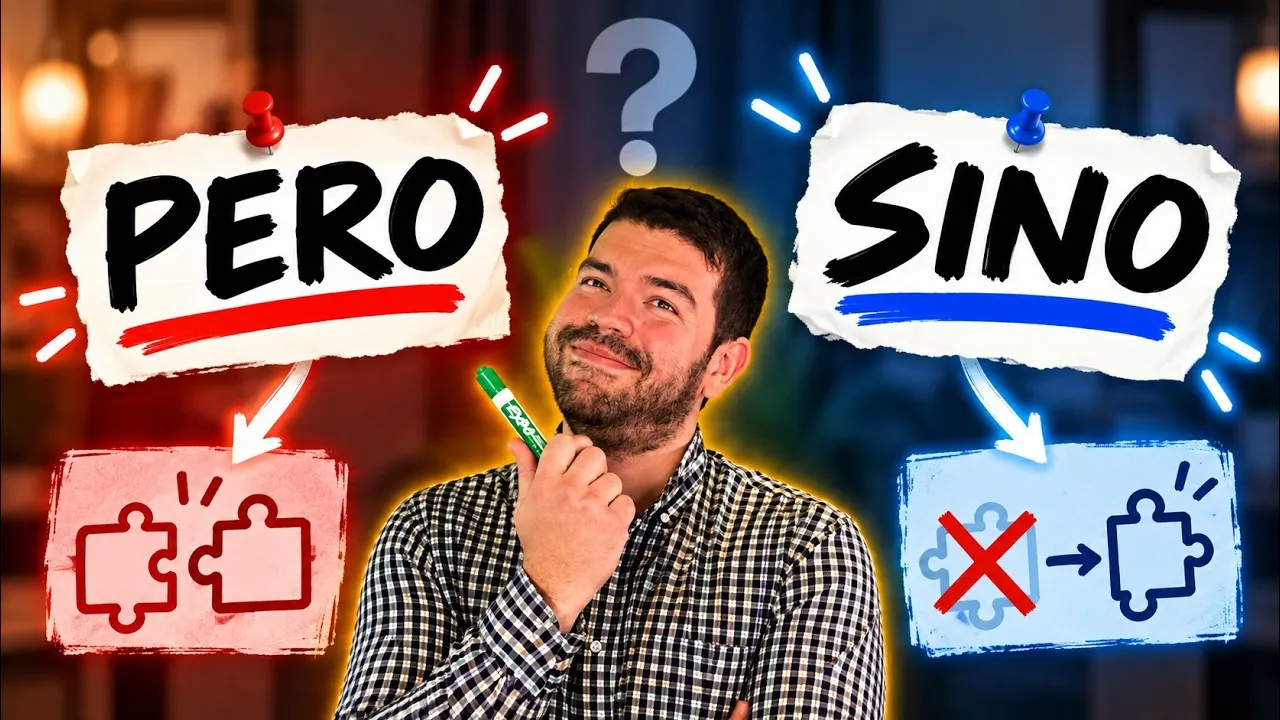
Don't memorize pero = "but." Ask yourself: am I adding a second idea, or am I fixing the first one?
- Adding a contrast, and both ideas are true: pero.
- Rejecting the first idea and replacing it: sino.
That's the key. Pero is contrast. Sino is correction.
Pero: both things are true
With pero, you say something, and then you add something else that pulls in a different direction. Nothing gets cancelled.
- Es pequeño, pero cómodo. It's small, but comfortable. (It's small. It's also comfortable. Both true.)
- Quiero ir, pero no tengo tiempo. I want to go, but I don't have time. (You still want to go. You just added a problem.)
- No es caro, pero es bueno. It's not expensive, but it's good. (Cheap and still good. Two ideas that coexist.)
Notice the third one. It starts with no, and it still takes pero. A negative at the start doesn't automatically mean sino. What matters is what the second half does. Here, "it's good" doesn't correct "it's not expensive." It adds to it.
Sino: the first option is wrong, here's the right one
With sino, Spanish doesn't add another fact. It says: that first option? No. Here's the corrected one. The structure is always not A, but B. You reject A and put B in its place.
- No es rojo, sino azul. It's not red, but blue.
- No vivo en Madrid, sino en Barcelona. I don't live in Madrid, but in Barcelona.
- No quiero café, sino té. I don't want coffee, I want tea.
- No vivo en México, sino en Colombia. I don't live in Mexico, I live in Colombia.
This is why sino normally comes after a negative. You're correcting something: what someone said, what someone assumed, or what you almost said yourself. And here's a quick test. If you could say "but rather" or "instead" in English, you want sino.
Compare them side by side
Pay attention here, because these pairs are where it clicks:
- No es barato, pero me gusta. It's not cheap, but I like it. (Not cheap, and I still like it. Both true.)
- No es barato, sino caro. It's not cheap, it's expensive. (Cheap was wrong. Expensive replaces it.)
- No es grande, pero tiene mucha luz. It's not big, but it gets a lot of light.
- No es grande, sino pequeño. It's not big, it's small.
Same opening, different job. In the pero sentences, you keep the first idea and add another. In the sino sentences, the second word takes the first one's seat. English hides this difference inside one word. Spanish makes you choose. Isn't it beautiful? It is.
Sino que: when the correction has its own verb
Now look at this sentence: No trabaja, sino que estudia. He doesn't work, he studies.
Why sino que and not just sino? Because what comes after the correction has its own conjugated verb: estudia. When the replacement is a full clause, a whole new action with a conjugated verb, you add que.
- No quiero café, sino té. Two nouns. No que.
- No voy a cocinar, sino que voy a pedir comida. I'm not going to cook, I'm going to order food. A full clause: the second action replaces the first.
- No corre, sino que camina. He's not running, he's walking.
- No me llamó, sino que me escribió. She didn't call me, she texted me.
So the pattern is simple:
- sino + a word or phrase: No es grande, sino pequeño.
- sino que + a conjugated verb: No corre, sino que camina.
One detail that helps: an infinitive isn't conjugated, so it doesn't need que. No quiero cocinar, sino pedir comida. I don't want to cook, I want to order food. Same idea, no que, because pedir isn't conjugated.
No solo... sino también
There's one more place where sino shows up, and you'll hear it all the time. When English says "not only... but also," Spanish says no solo... sino también.
- Habla no solo inglés, sino también francés. She speaks not only English, but also French.
- No solo es barato, sino también rico. It's not only cheap, but also tasty.
Here you're not rejecting the first idea. You're saying it's not the whole story. And the same rule about verbs applies: with a conjugated verb, it usually becomes sino que también. No solo cocina, sino que también limpia. He doesn't just cook, he also cleans. (Lucky roommates, right?)
The mistakes almost everyone makes
This is where many learners get stuck, and it makes total sense. Your English brain sees "but" and grabs the first Spanish word it learned for it, which is almost always pero. It happens to all of us. Here are the usual traps:
- Using pero for a correction. No es rojo, pero azul sounds off to a native speaker. You're replacing red with blue, so it's No es rojo, sino azul.
- Using sino without a negative. Es pequeño, sino cómodo doesn't work. Nothing was rejected, so there's nothing to correct. Both are true: Es pequeño, pero cómodo.
- Forgetting que before a conjugated verb. Say No trabaja, sino que estudia, with que.
- Adding que before a noun. No quiero café, sino que té is wrong. Two nouns, so skip the que: No quiero café, sino té.
- Mixing up sino and si no. They sound the same, but si no is two words and means "if not." Si no vienes, me voy. If you don't come, I'm leaving. Sino, one word, is the correction.
One more thing to notice. You'll also hear pero with sí after a negative: No es caro, pero sí es bueno. It's not expensive, but it is good. That sí just stresses the second idea. It's still contrast, so it's still pero.
And good news: this isn't a regional thing. The pero and sino split works the same way in standard Spanish in Mexico, Spain, Argentina and everywhere else it's spoken.
One scene, both words
Imagine you're at a party and someone guesses where you're from.
"¿Eres de España?" Are you from Spain?
"No, no soy de España, sino de Colombia. Pero viví en Madrid dos años." No, I'm not from Spain, I'm from Colombia. But I lived in Madrid for two years.
"¿Y trabajas aquí?" And do you work here?
"No, no trabajo aquí, sino que estudio. Pero me encanta la ciudad." No, I don't work here, I study. But I love the city.
Look at what happened. Every sino fixed a wrong guess. Every pero added something new that was also true. Same conversation, two different jobs.
Recap
- Pero adds a contrast, and both ideas are true: Es pequeño, pero cómodo.
- Sino comes after a negative, rejects one option and replaces it: No es rojo, sino azul.
- Sino que is for when the correction has its own conjugated verb: No trabaja, sino que estudia.
If you only keep one line, keep this one: pero adds, sino replaces.
Now it's your turn
Write two sentences about yourself. In the first, fix a wrong guess someone could make about you, using sino or sino que. In the second, add something that's also true, using pero. For example: No soy profesor, sino ingeniero. Pero me encanta enseñar. Write yours, then say it out loud.
Next lesson: pero and sino are connectors, and Spanish has plenty more that make your sentences flow. Keep going with the top Spanish connectors to speak and write better. And if "one English word, two Spanish words" sounds familiar, it's the same story as por or para and ser and estar. Nos vemos.