How to Give Advice in Spanish: 6 Ways Beyond Deberías
Deberías, podrías, yo que tú, te convendría, tendrías que: six natural ways to give advice in Spanish, and how strongly each one pushes the other person.
WorldsAcross team · November 13, 2026
In this article · 10 sections
Deberías descansar. Podrías descansar. Tendrías que descansar. Three sentences, one piece of advice: get some rest. In English you'd probably say "you should rest" every time. So why does Spanish give you three versions, and why don't they sound the same?
Here's the thing. English leans on "should" for almost all advice. Spanish has a word for it, deberías, but native speakers don't stop there. They change the structure of the sentence to set the tone: a gentle option, a personal opinion, a practical tip or real pressure.
By the end of this, you'll have six natural ways to give advice in Spanish, and a simple scale in your head for how strong each one sounds.
The question to ask yourself
Most learners ask, "How do I translate should?" That's the wrong question. Don't memorize should = deberías. Ask yourself a better one:
How strongly do I want to push?
Once you know the answer, the structure picks itself. (If you want to tell someone straight out what to do, that's a different tool: the imperative. Today we stay with advice.) Let's start with the one you already know.
1. Deberías: the closest thing to "should"
Deberías is the conditional of deber, and it's the form you probably learned first. It's a clear recommendation: you think this is the right thing to do.
- Deberías descansar. You should rest.
- Deberías hablar con tu jefe. You should talk to your boss.
- Deberías dormir más. You should sleep more.
Nothing wrong with it. It's correct, it's common, and people will understand you perfectly. The problem is only when it's the only tool you have.
2. Podrías: much softer, just an option
Swap deberías for podrías (you could) and the advice relaxes. You're not telling the person what to do. You're putting an option on the table.
- Podrías descansar. You could rest.
- Podrías hablar con Ana. You could talk to Ana.
- Podrías intentarlo otra vez. You could try again.
Notice how much room this leaves the other person. It's great when you don't know the whole story, or when the person didn't really ask for advice. If you like this softer register, you'll see the same move in how to soften an order in Spanish.
3. Yo que tú: personal, and very common
This one is everywhere in real conversation. Yo que tú means "if I were you," and it's followed by a verb in the conditional. Pay attention here: the verb is about me, not about you. I'm telling you what I would do.
- Yo que tú, no iría. If I were you, I wouldn't go.
- Yo que tú, hablaría con ella. If I were you, I'd talk to her.
- Yo que tú, esperaría un poco. If I were you, I'd wait a bit.
That's why it feels personal. You're not giving an order; you're sharing your own judgment, and the other person decides. You'll also hear the longer version, Si yo fuera tú… (if I were you…), which uses the imperfect subjunctive. It's correct and you'll run into it, but yo que tú is the short, everyday one.
4. Yo en tu lugar: almost the same, a touch more neutral
Yo en tu lugar means "in your place" or "in your shoes." It works exactly like yo que tú: then a verb in the conditional.
- Yo en tu lugar, aceptaría la oferta. In your shoes, I'd accept the offer.
- Yo en tu lugar, no diría nada. In your shoes, I wouldn't say anything.
Honestly, these two are very close, and these aren't two perfectly separated boxes. If anything, yo en tu lugar sounds slightly more neutral, a bit less "between friends." If you're unsure, use yo que tú with people you know and either one anywhere else.
5. Te convendría / te vendría bien: what would be good for you
Now the angle changes. Instead of "you should" or "I would," you talk about what would benefit the other person. Te convendría (it would suit you, it would be in your interest) and te vendría bien (it would do you good) are both followed by an infinitive.
- Te vendría bien descansar. It would do you good to rest.
- Te convendría salir más temprano. You'd be better off leaving earlier.
- Te convendría ahorrar un poco. It would be smart to save a little.
- Te vendría bien hablar con un médico. It would be good for you to talk to a doctor.
These are perfect for practical decisions: money, work, timing, health. Look at the logic. You're not judging the person. You're pointing at the result.
6. Tendrías que: looks like advice, pushes much harder
This is the trap. Tendrías que looks like polite advice because it's in the conditional, just like deberías. But it comes from tener que (to have to), and it sounds much stronger, closer to "you really should" or "you need to."
- Tendrías que descansar. You really should rest.
- Tendrías que hablar con él. You really need to talk to him.
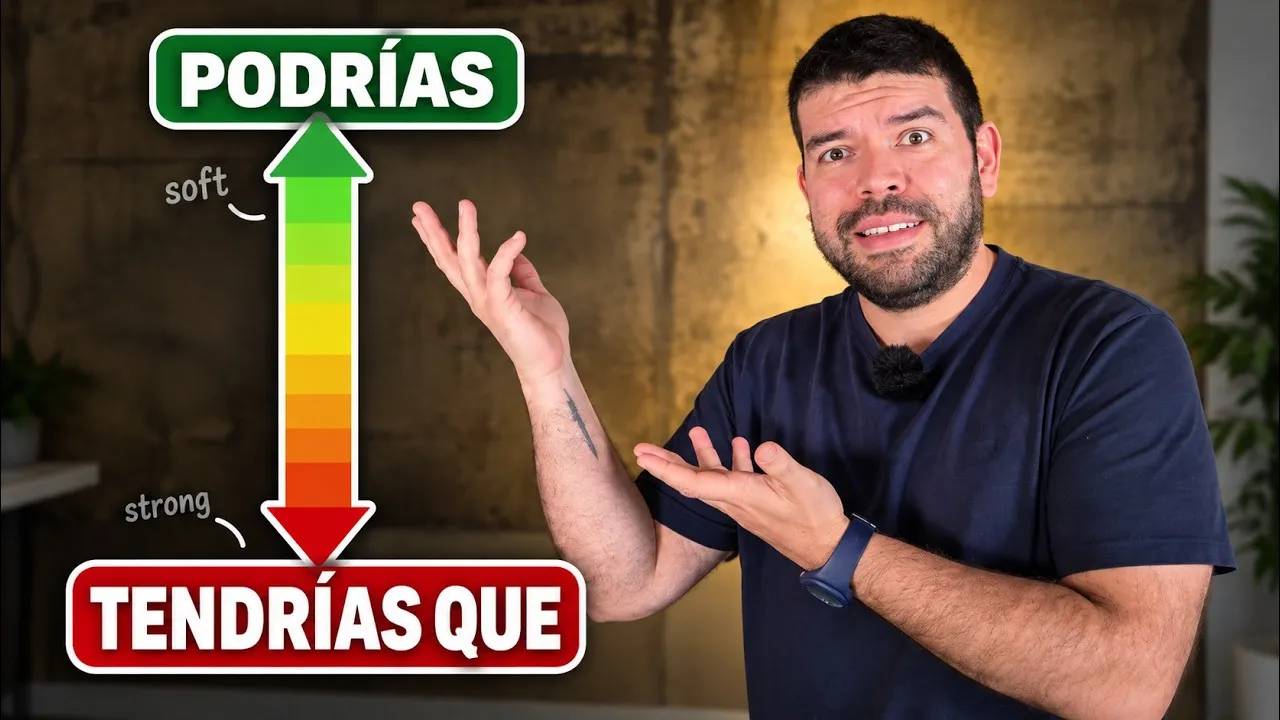
Here's the scale, with one verb so you can feel the difference:
- Podrías llamarlo. You could call him. (an option)
- Deberías llamarlo. You should call him. (a recommendation)
- Tendrías que llamarlo. You really need to call him. (pressure)
Ojo (watch out): tone and context still matter. Said softly, with a worried face, tendrías que can sound caring. Said fast, it can sound like a lecture. The structure sets the starting point; your voice does the rest.
One scene, six ways
Imagine a friend tells you they hate their job. Every morning, the same dread. A little dramatic, yeah, but we've all been there. You think they should look for another one. Look at how the same advice changes with each structure:
- Podrías buscar otro trabajo. You could look for another job. (Just an idea.)
- Deberías buscar otro trabajo. You should look for another job. (A clear recommendation.)
- Yo que tú, buscaría otro trabajo. If I were you, I'd look for another job. (My personal take.)
- Yo en tu lugar, buscaría otro trabajo. In your shoes, I'd look for another job. (Same, slightly more neutral.)
- Te convendría buscar otro trabajo. It would be good for you to look for another job. (Focused on what's best for them.)
- Tendrías que buscar otro trabajo. You really need to look for another job. (Pressure.)
Same idea, six different relationships between you and your friend. That's the key. Spanish isn't giving you six translations of "should." It's giving you six levels of push.
Recap
- Soft: podrías offers an option. Te convendría and te vendría bien point at what would benefit the person.
- Personal: yo que tú and yo en tu lugar + conditional share what you would do.
- Direct: deberías recommends; tendrías que pushes hard.
Don't stop at should = deberías. Before you give advice, ask yourself: how strongly do I want to push?
Now it's your turn
A friend says to you: "No duermo bien." (I don't sleep well.) Write one piece of advice for them using any of the six structures. Then try it again with a different one and notice how the tone changes. Maybe Yo que tú, no tomaría café por la noche. Always a good idea, right?
Most of these structures run on the conditional, so if you want to get more comfortable with those -ía endings, your next lesson is how to use the conditional tense in Spanish. And to see how the conditional changes tone beyond advice, read how the conditional changes tone in Spanish. Nos vemos.