
Ir vs Venir, Llevar vs Traer: Spanish Movement Verbs
Traer or llevar? Venir or ir? Spanish picks the verb by where the speaker is, not the object. One arrow picture makes it click.
WorldsAcross team · November 14, 2026
In this article · 8 sections
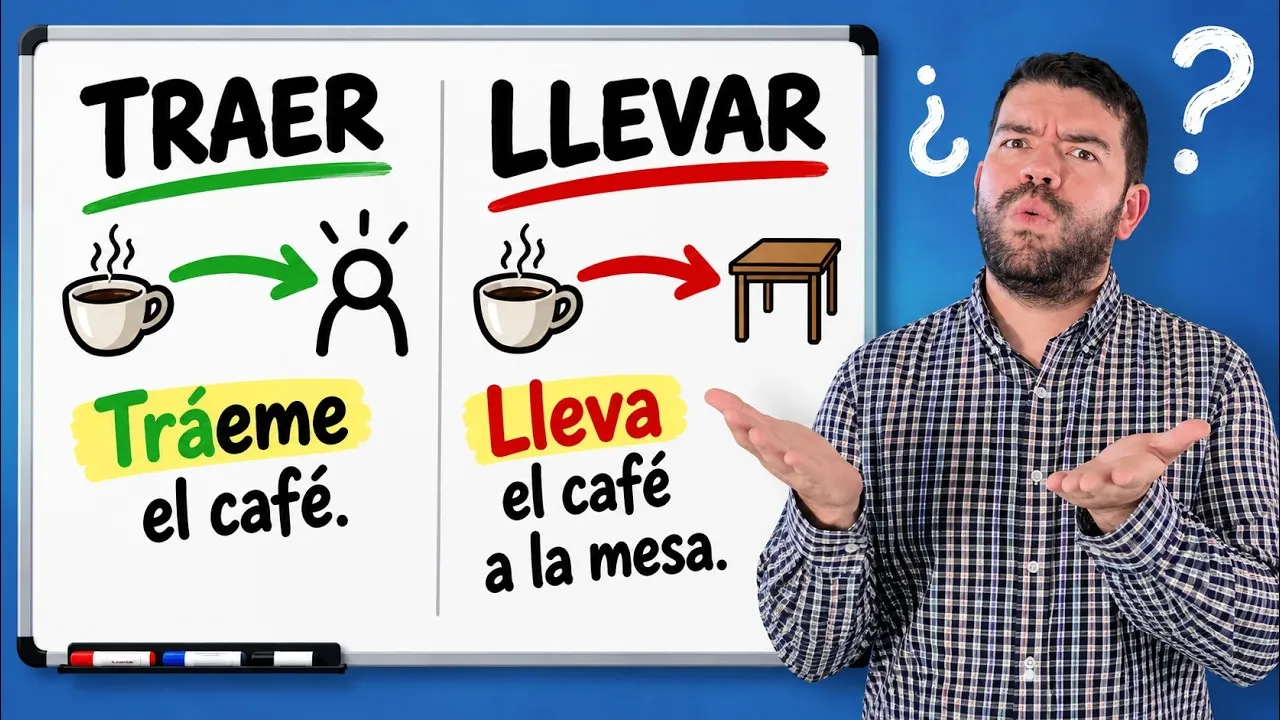
Tráeme el café. Lleva el café a la mesa. Same coffee, same movement of a cup through the air. But Spanish changes the verb, and the reason has nothing to do with the coffee.
English has bring and take, and they don't always line up with Spanish. So you try to memorize traer = bring and llevar = take, and then one day you say "I'll bring it to your house" and the Spanish comes out wrong. This is where a lot of learners get stuck. Don't worry. One question fixes it.
By the end of this lesson, you'll have one mental picture for traer and llevar, and you'll see that the same picture works for venir and ir too.
The question: is it coming here?
Don't ask only "where is the object going?" Ask yourself: is it moving toward here, where I am, or toward somewhere else?
Imagine an arrow. If the arrow points at the speaker, Spanish uses traer (and venir). If the arrow points anywhere else, Spanish uses llevar (and ir). English cares about the object. Spanish cares about your point of view.
Traer: toward here
Traer means something comes toward the speaker, or toward the place the speaker is treating as "here".
- Tráeme el café. Bring me the coffee.
- ¿Puedes traer agua? Can you bring water?
- Traje mi computadora a la oficina. I brought my computer to the office. (I'm at the office now.)
- Trae a tu amigo mañana. Bring your friend tomorrow. Bring him where? Here.
Llevar: toward somewhere else
Keep the same coffee, but change the destination. It's no longer coming toward me. It's going somewhere else. Look at this:
- Lleva el café a la mesa. Take the coffee to the table.
- Lleva esto a la cocina. Take this to the kitchen.
- Voy a llevar los documentos a la oficina. I'm going to take the documents to the office.
- ¿Puedes llevar a Juan al aeropuerto? Can you take Juan to the airport?
Both verbs work with things and with people: Trae a tu hermano (Bring your brother), Lleva a los niños a la escuela (Take the kids to school). Notice the little a before people. And with pronouns, the arrow stays the same: Tráemelo (Bring it to me), toward me. Llévaselo a Ana (Take it to Ana), toward someone else.
Ir and venir: the same arrow, with you moving
Here's the shortcut. Venir works like traer, and ir works like llevar. The only difference is that now you're the one moving, not the coffee.
- Ven aquí. Come here. Toward the speaker.
- ¿Vienes a mi casa el sábado? Are you coming to my place on Saturday? (I'm the host, so my place is "here".)
- Voy al supermercado. I'm going to the supermarket. Away from here.
- Mañana voy a tu casa. Tomorrow I'm coming to your place.
Pay attention to that last one. English says "I'm coming to your place". Spanish says voy, because from where I'm standing, your place is "there", not "here".
The trap: when English says bring and Spanish says llevar
This is where English can trick you. English often uses bring and come for movement toward the person you're talking to. Spanish usually doesn't. It looks at the speaker's "here".
- Mañana te lo llevo. I'll bring it to you tomorrow. (It's moving away from me, toward you.)
- ¡Ya voy! I'm coming! (Someone calls you from the kitchen. You go toward them, so: voy.)
That ¡Ya voy! feels strange at first. You're definitely coming, right? But Spanish asks: is the movement toward the speaker's here? No. So it's ir. Once you hear it in real life a few times, it starts to sound obvious.
Honest note: the speaker can choose what counts as "here", and there's some overlap in real use. You may hear people mix these, and it's not a disaster. But the arrow picture will be right most of the time, and it's the safe default.
One party, three phone calls
Let's take one situation and move the speaker around. There's a party on Saturday. You're bringing wine.
- I'm at home and the party is at my place: Trae vino. Bring wine. The wine is coming toward me.
- Neither of us is at the party yet: Lleva vino a la fiesta. Take wine to the party. The party is "there". (Where is the party, by the way? Nobody ever says.)
- I'm already at the party and I call you: Trae vino a la fiesta. Bring wine to the party. Same destination, but now I'm standing there, so it's "here".
Same wine, same party. The only thing that changed was where the speaker was. That's the whole lesson in one scene. Isn't it beautiful? It is.
You'll hear this all the time in plans: ¿Qué vas a traer? What are you bringing? ¿Qué vas a llevar? What are you taking? The answer depends on the destination and on who's asking.
Good catch. No, it doesn't have to be negative. Estar para is about your mood or condition to do something, and that can be positive: Hoy estoy para salir. Today I'm in the mood to go out. But it isn't always a perfect match for "I'm up for it". Depending on the country, a very natural option is Tengo ganas de salir. I feel like going out.
Recap
- Traer and venir: movement toward here, toward the speaker. Tráeme el café. Ven aquí.
- Llevar and ir: movement toward somewhere else. Lleva el café a la mesa. Voy a tu casa.
- The same destination can take a different verb depending on where the speaker is. Don't memorize two translations. Ask yourself: is it coming here, or going there?
Your turn
Imagine I'm already at your house, and you call me. How would you say "Bring the keys"? Now imagine we're both at the office. How would you say "Take the keys to my house"? Write both sentences down.
If the idea of "here" and "there" clicked for you, the next step is Aquí vs. Acá in Spanish. Same arrow, different words.
Watch Profe Juan's full lesson on traer and llevar on Learn Spanish From Scratch.