Spanish Words That Change Meaning by Country
Coger, concha, guagua, torta: Spanish words that are harmless in one country and surprising in another, with a safe default for each.
WorldsAcross team · November 14, 2026
In this article · 10 sections
Voy a coger el autobús. In Madrid, that's the most normal sentence in the world: I'm going to catch the bus. Say the same thing in Mexico City or Buenos Aires, and people may hear something very different. Maybe a laugh. Maybe an awkward silence.
That's one of the strangest parts of learning Spanish. A word can be completely harmless in one country and vulgar, funny or just confusing in another. So which Spanish is right? Spoiler: all of them. The question is a different one.
By the end of this lesson, you'll know the most famous traps, a safe default for each, and one habit that keeps you out of trouble anywhere.
The question to ask yourself
Don't ask "what does this word mean?" Ask yourself: what does this word mean here, where I am?
English has this too. Ask for a "biscuit" in London and in Atlanta and you get two different things. Spanish is spoken in more than twenty countries, so it has a lot more of it. None of these words is wrong. They're just local. It's not what you say, it's where you say it.
Coger: the classic trap
In Spain, coger is an ordinary everyday verb. You'll also hear it in countries like Colombia, Cuba and the Dominican Republic.
- Voy a coger el autobús. I'm going to take the bus.
- Coge las llaves. Grab the keys.
- Cogí un taxi. I took a taxi.
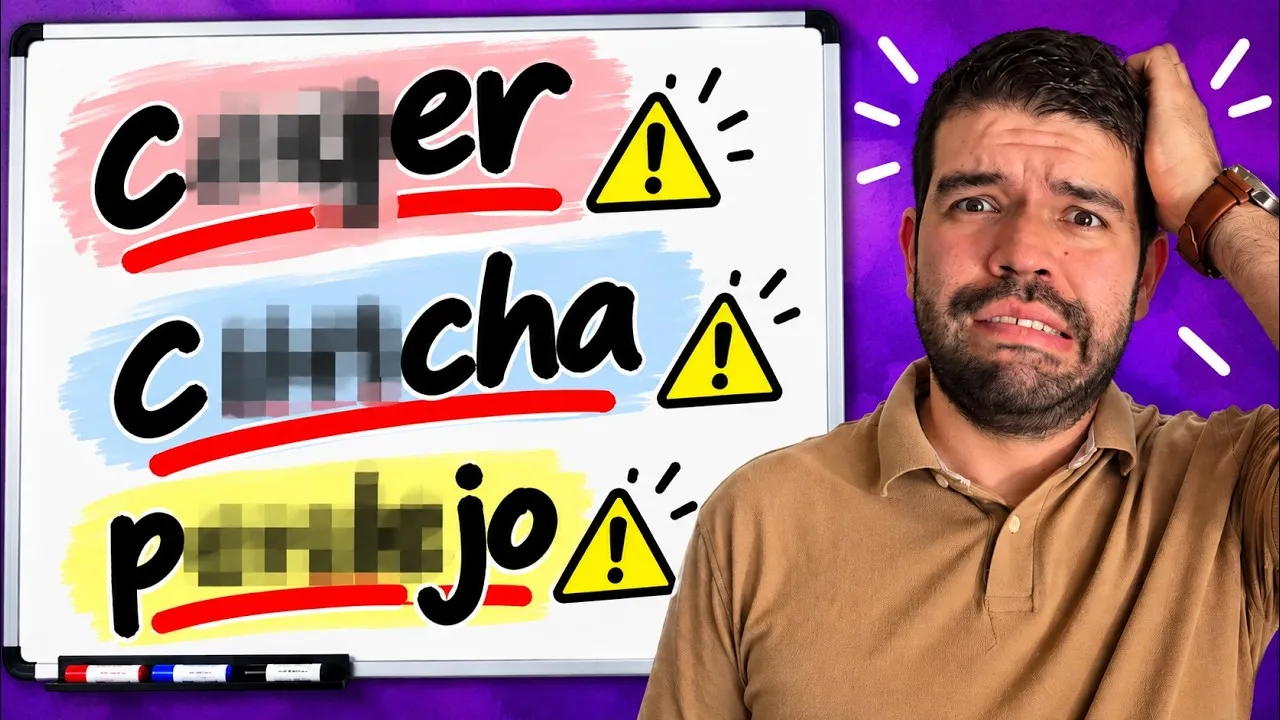
Ojo: in a large part of Latin America, including Mexico and Argentina, coger is also a vulgar slang word for having sex. Nobody will think you're rude on purpose, but expect a reaction.
That doesn't mean nobody in Latin America uses the normal meaning. Regional usage is messy. But if you want Spanish that works across countries, the safe default is tomar: Voy a tomar el autobús. Tomé un taxi. And for objects, agarrar is very common in Latin America: Agarra las llaves. Grab the keys.
So the lesson isn't "coger is a bad word". It's "coger is completely normal in one place and very different in another".
Concha: a bakery order that can go wrong
In Mexico, a concha is a classic sweet bread, round, with a sugary top that looks like a shell. You walk into a bakery and ask for one, no problem. Honestly, they're very good.
- Quiero una concha, por favor. I'd like a concha, please.
Ojo: in Argentina, Chile and Uruguay, concha is also a vulgar word for part of the female anatomy.
Now imagine learning Mexican Spanish, landing in Buenos Aires and talking enthusiastically about las conchas you loved in Mexico. Perfect grammar. Very different reaction. Safe default: use it for the bread when you're in Mexico, and outside Mexico, if you need to talk about the bread, say pan dulce mexicano (Mexican sweet bread).
Insults change strength too
Some words aren't vulgar in one place and innocent in another. They're insults everywhere, but their meaning and intensity change a lot. A word that sounds like friendly teasing in one country can be a real insult in Mexico, the kind that starts a fight.
Here's the safe rule: don't borrow an insult from a TV show or a song. Listen to how locals use it, with whom, and in what tone, before you even think about using it yourself. And if you're not sure, don't.
Same word, different picture
Not every regional difference is risky. Sometimes two native speakers hear the same word and just picture completely different things. Look at this:
- Guagua. In Ecuador and Chile, a guagua can be a baby. In the Caribbean, including Cuba and the Dominican Republic, a guagua is a bus. So Voy en guagua means I'm going by bus... unless you're in the Andes, where people might ask why you're riding on a baby.
- Torta. In many South American countries, torta means cake: Compré una torta para tu cumpleaños. I bought a cake for your birthday. In Mexico, a torta is usually a sandwich. So Vamos a comer una torta is dessert in one place and lunch in another. If you want cake in Mexico, ask for un pastel.
Notice what this does to a common question. "What's the Spanish word for cake?" sometimes doesn't have one answer for the whole Spanish-speaking world. You have to be a little flexible.
When the whole sentence changes: hasta
Sometimes the difference goes deeper than vocabulary. The words stay exactly the same, and the logic of the sentence changes.
- Abre hasta las nueve. For many speakers: it's open until nine.
But in Mexico and parts of Central America, you can hear that same structure meaning "it doesn't open until nine". One version points to the closing time, the other to the opening time. Same words, very different plan for your morning.
Safe default, which works everywhere: Está abierto hasta las nueve (It's open until nine) and No abre hasta las nueve (It doesn't open until nine).
One trip, four buses
Let's put it together. Imagine you're traveling through four cities, and every morning you say "I'm going to catch the bus":
- In Madrid: Voy a coger el autobús.
- In Mexico City: Voy a tomar el camión. (Yes, camión is also a truck. Context does the work.)
- In Buenos Aires: Voy a tomar el colectivo.
- In Havana: Voy a coger la guagua.
Four cities, four natural sentences, all correct. And if you forget everything else, Voy a tomar el autobús will be understood in all of them. Isn't it beautiful? It is.
A reader asked: how do I order at a taco stand?
A viewer asked how to order food at a taco stand or a quick restaurant, because the information out there seems to conflict.
It conflicts because ordering tacos in Mexico City and ordering lunch in Bogotá are two different scripts. Nothing's wrong. It's just a different street. At a stand in Mexico, you may hear ¿Qué le doy? (What can I get you?). Answer with a number and a filling: Dos de pastor, con todo (Two al pastor, with everything, meaning onion and cilantro), or sin cebolla (without onion). To pay, don't ask for la cuenta. Ask ¿Cuánto le debo? (How much do I owe you?). And in Colombia, you'll hear ¿Me regala un café? Nobody is asking for a gift. It's just a polite way to order.
Recap
- Coger and concha are everyday words in some countries and vulgar in others. Safe defaults: tomar for buses and taxis, and concha only for the bread, in Mexico.
- Guagua can be a baby or a bus, torta can be a cake or a sandwich, and even hasta can point to the opening or the closing time.
- The goal isn't to be scared of regional Spanish. It's to stop assuming one word means the same thing everywhere. Ask yourself: what does this word mean here?
Your turn
Think of one country you'd love to visit. How would you say "I'm going to take the bus to the bakery" there? Write it with tomar first, then look up what locals call the bus and write it again.
Want more? See how greetings change from country to country in Regional Vocabulary: Words from Different Spanish-Speaking Countries, and the words that fool English speakers in 10 Most Common False Cognates in Spanish.
Watch Profe Juan's full lesson on words that change meaning by country on Learn Spanish From Scratch.