How to Use Echar in Spanish: Add, Fire, Miss, Effort
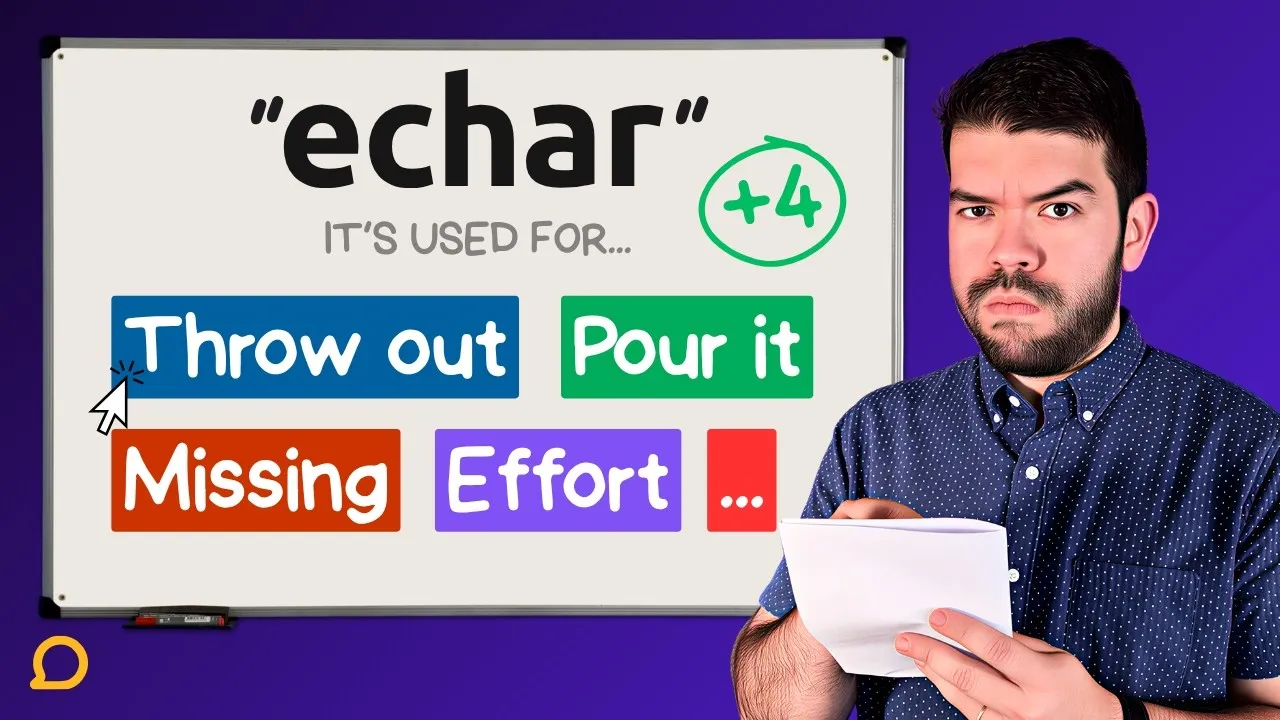
Échale sal, lo echaron del trabajo, te echo de menos, échale ganas. Echar isn't just throw. Learn the one idea behind its everyday uses: something goes outward.
WorldsAcross team · November 13, 2026
In this article · 9 sections
Échale sal. Lo echaron del trabajo. Te echo de menos. ¡Échale ganas! Same verb, echar, four times. Four very different situations: cooking, getting fired, missing someone, and a pep talk.
Here's what usually happens. You learn that echar means "to throw." Fine. Sometimes that's true. Then someone in the kitchen says échale sal, and you wonder why they want you to throw salt across the room. This is where many learners decide echar is a random verb with a long list of meanings. Tranquilo. Spanish uses echar in dozens of everyday expressions, and most of them are connected by one idea.
By the end of this article you'll have that idea, and one question to ask every time you hear echar.
The core idea: something goes outward
Let me illustrate the core idea first. Echar means to put, send or throw something, to make it go outward, toward somewhere. Sometimes that something is salt going into a pot. Sometimes it's a person going out the door. Sometimes it's your own effort, sent into a task.
So don't memorize echar = throw. Ask yourself one question: what is being sent outward, and where does it go?
1. Add, put, pour
Imagine you're cooking and someone tastes the soup.
- Échale sal. Add some salt. (Not "throw salt at it," don't worry.)
- Le echo azúcar al café. I put sugar in my coffee.
- Le eché agua a la planta. I watered the plant. Literally, I poured water on it.
Pay attention here. Nobody is throwing anything. The salt, the sugar and the water just go from your hand into something else. That's why in everyday Spanish this echar usually comes out in English as add, put or pour.
Notice the little le, too: le echo, échale. It points to where the thing goes: the coffee, the plant, the soup. You'll hear it almost every time.
2. Send someone away
Now the thing going outward is a person.
- Lo echaron del trabajo. He got fired. Literally, they threw him out of the job.
- Me echaron de la escuela. I got kicked out of school.
- Lo echaron de la casa. They kicked him out of the house.
Same picture. Someone is sent away, out of a place. English reaches for "fired" or "kicked out." Spanish keeps returning to echar.
Look at the form: echaron, "they threw out." Spanish often doesn't say who did it. You just know he's on the outside now.
3. Echar de menos: to miss someone
Te echo de menos. I miss you.
This is the one that confuses people, and honestly, nothing is being thrown here. You can try to stretch the picture to fit, but the useful advice is simpler: learn echar de menos as one full expression, a single block that means "to miss."
- Te echo de menos. I miss you.
- Echo de menos a mi familia. I miss my family.
A quick regional note. Echar de menos is very common in Spain, and it's used in Latin America too. But in much of Latin America, you'll more often hear extrañar: Te extraño. I miss you. Neither one is wrong. If you're unsure, both will be understood everywhere. Just know that when you hear te echo de menos, nobody is throwing you anywhere.
4. Echarle ganas: give it your best
- ¡Échale ganas! Give it your best! Go for it!
- Hay que echarle ganas. You have to put in the effort.
Ganas is desire, the will to do something. And here's where the core idea comes back: you take that energy and you send it into whatever you're doing. A test, a new job, learning Spanish. You put your effort out there.
This one is extremely common in Mexico and in other Spanish-speaking countries. You'll hear it from parents, coaches and friends, and it's a really nice thing to say to someone who's having a hard time.
One more everyday chunk built on the same picture: echar un vistazo, to take a look. Voy a echar un vistazo. I'm going to take a look. Your eyes go out toward something, quickly.
One dinner, all the uses
Let's put everything into one scene. You're cooking dinner, and a friend comes over to talk.
- Le echo aceite a la sartén. I pour oil into the pan. Something added.
- Mi amigo me dice: "Me echaron del trabajo." My friend tells me, "I got fired." Someone sent away.
- "Echo de menos a mis compañeros." "I miss my coworkers." The full idiom.
- Le echo un vistazo a la sopa y le echo sal. I take a look at the soup and add salt. Eyes out, salt in.
- Le digo: "Tranquilo. ¡Échale ganas! Vas a encontrar algo mejor." I tell him, "Relax. Give it your best! You're going to find something better." Effort, sent outward.
Pour, fire, miss, look, give it your all. Five English verbs, one Spanish verb. Isn't it beautiful? It is.
The pattern, honestly
Add, throw out, miss, give your effort. They look unrelated, but most of them grew from the same movement: putting, sending or directing something outward. When you hear a new echar expression, ask what is going out and where it lands, and you'll often decode it on the spot.
To be honest about the edges: not every expression fits neatly. Echar de menos is the clearest example. For those, don't fight the picture. Learn them whole, the way you'd learn any idiom. The question gets you most of the way, and the idioms fill in the rest.
Recap
- Something goes into something else: Échale sal. Le echo azúcar al café. Add, put, pour.
- Someone goes out: Lo echaron del trabajo. Your effort goes out: ¡Échale ganas!
- Echar de menos means to miss; learn it whole (extrañar is more common in much of Latin America). Don't memorize echar = throw. Ask: what is being sent outward, and where does it go?
Your turn
Write one sentence with echar about your day: something you added to your food or coffee, someone you miss, or something you need to echarle ganas to this week. Then ask yourself: what went outward, and where did it go?
Next, read how to use poner, where something lands in a new place instead of going outward. If you like this kind of verb, how to use sacar and salir, irse and dejar: three ways to say leave work the same way. Profe Juan explains every use of echar in the full lesson on Learn Spanish From Scratch. Watch it above.