Estar Por vs. Estar Para: One Tiny Word in Spanish
Estoy por salir means you're about to leave. No estoy para salir means you're not up for it. Learn estar por and estar para with one simple question.
WorldsAcross team · November 13, 2026
In this article · 10 sections
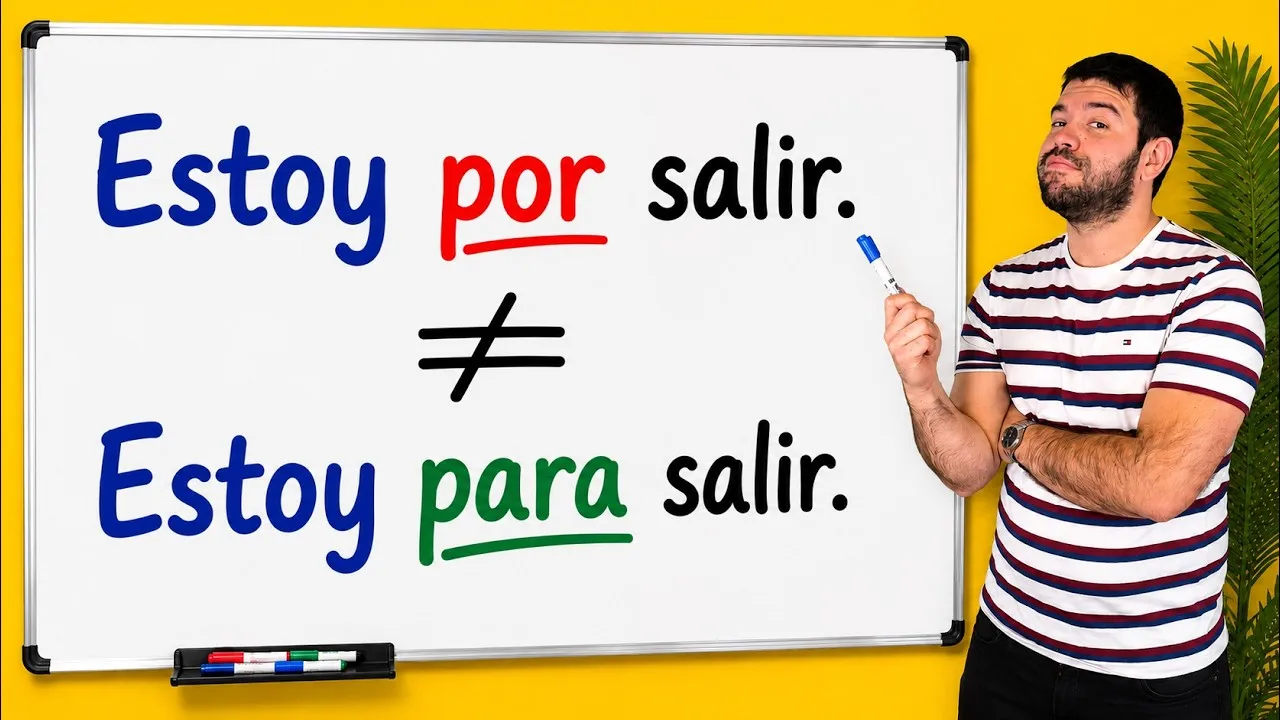
Estoy por salir. I'm about to leave. No estoy para salir. I'm not in the mood to go out.
Same verb, estar. Same action, salir. And one tiny preposition flips the whole meaning.
This is where many learners get stuck, because por and para already feel like a coin toss. Now they show up after estar, and English translates them with completely different phrases: "about to," "remains to be," "not in the mood for," "needs to be." Tranquilo. You don't need four rules. You need one way of looking at the sentence.
By the end of this, you'll have a single question you can ask yourself every time you see estar por or estar para.
The idea in one line
Pay attention here, because this is the whole lesson: estar por looks toward an action that hasn't happened yet. Estar para describes whether someone or something is in the right condition for it.
Imagine a door. With estar por, you're looking at the door and the action is on the other side, still ahead of you: about to happen, or still waiting to be decided. With estar para, you're looking at the person, or the thing, and asking: is it ready for this? Is it in the mood, in the shape, in the state for it?
Estar por: about to
The most common use is estar por + infinitive, meaning "to be about to."
- Estoy por salir. I'm about to leave.
- Estaba por llamarte. I was about to call you.
- Estamos por empezar. We're about to start.
- Está por llegar. He's about to arrive. (Or she is, or it is: the bus, the package, your cousin.)
If this sounds close to estar a punto de, you're right. Estoy a punto de salir and Estoy por salir both put you right before the action. A punto de is a safe choice anywhere, so if you're unsure, use it.
One honest note: in some regions, estar por + infinitive can also lean toward "I'm inclined to" or "I'm thinking of." Context tells you which one you're hearing. For now, keep "about to" as your main meaning.
Estar por: still unresolved
Now look at this. The same "still ahead" idea shows up when something hasn't been settled yet.
- Todavía está por decidir. It's still to be decided.
- Eso está por verse. That remains to be seen. You'll also hear Está por ver.
- La fecha está por confirmar. The date is still to be confirmed.
Notice the pattern. Nobody is about to do anything here. The decision, the result, the confirmation: all of it is still waiting on the other side of the door. Spanish sees one idea, "not done yet." English needs "about to" in one sentence and "remains to be" in the next. If todavía caught your eye, read ya vs. todavía, because it pairs beautifully with this structure.
Estar para: in the mood, in the condition
Now the other side. With estar para, the question is whether someone is in the right state for something. You'll hear it a lot in the negative.
- No estoy para bromas. I'm not in the mood for jokes.
- Hoy no estoy para salir. I'm not up for going out today.
- No estoy para discutir. I'm not in the mood to argue.
- Después de doce horas de trabajo, no estoy para cocinar. After twelve hours of work, I'm not in any shape to cook.
That last one is very real, right? Nothing is wrong with the kitchen. The problem is your energy. That's exactly what estar para is describing. And it fits with what estar does in general: it talks about states and conditions. If you want the bigger picture on that verb, read how to use ser and estar correctly.
Estar para: describing circumstances
Let me give you another example. Estar para can also describe the condition of a thing or a situation.
- Ese teléfono está para cambiarlo. That phone needs replacing. It's in a state where the obvious next step is a new one.
- Está para llover. It looks like it's going to rain.
Ojo (watch out) with that weather one. How people say it varies by region, and you'll also hear está por llover in many places. These aren't two perfectly separated boxes. If you're unsure, parece que va a llover works everywhere.
Compare them side by side
Here's a pair that shows the difference clearly:
- Está por decidir. It's still to be decided. The decision is ahead of us.
- No estamos para tomar decisiones ahora. We're not in a state to make decisions right now.
Both sentences are about a decision. The first looks at the decision itself: not made yet. The second looks at the people: not in the right condition to make it. That's the key.
So the rule is a question you ask yourself: "Is the speaker looking at something still ahead, or describing whether conditions are right for it?" Still ahead: por. Conditions: para.
Don't memorize a translation. Learn chunks.
Here's the trap. Learners memorize estar por = "about to" and then freeze when they see está por verse. Or they learn estar para = "in the mood" and get lost with the phone that está para cambiarlo. One English phrase per structure won't hold.
Instead, learn a few short chunks the way you'd learn a song lyric:
- estar por salir, estar por llegar, está por ver
- no estoy para bromas, no estoy para discutir
Say them out loud. When one pops up in conversation, your ear already knows the shape.
One scene, both forms
Imagine it's Friday evening. Your friend Lucía texts you.
Lucía: ¡Hola! ¿Salimos esta noche? Hay un concierto en el centro.
Tú: Ay, no sé. Hoy no estoy para salir. Trabajé doce horas.
Lucía: Vamos, un ratito. Estoy por salir de casa.
Tú: De verdad, no estoy para nada. Ni para cocinar.
Lucía: ¿Y mañana?
Tú: Eso está por verse.
In English: Lucía asks if you're going out tonight, there's a concert downtown. You say you're not up for going out, you worked twelve hours. She says come on, just for a bit, she's about to leave the house. You say honestly, you're not up for anything. Not even cooking. She asks about tomorrow. You say that remains to be seen.
Look at the pairs. Lucía is about to leave: estoy por salir, the action is right ahead. You are not in the condition: no estoy para salir, no estoy para nada. And tomorrow? Still unresolved: eso está por verse. Same verb the whole time. The preposition tells you where the speaker is looking.
Recap
- Estar por + infinitive: about to. Estoy por salir. Close to estar a punto de.
- Estar por for unresolved things: still to be done or decided. Está por decidir. Eso está por verse.
- Estar para: in the right condition or mood, or not. No estoy para bromas. Ese teléfono está para cambiarlo.
And the one line to keep: ask whether the speaker is looking at something still ahead, or at whether conditions are right for it.
Now it's your turn
Translate these two sentences into Spanish:
- I was about to call you.
- I'm not in the mood to talk.
Ask yourself the question first: still ahead, or conditions? Then check: Estaba por llamarte. No estoy para hablar. Say both out loud, and write one of your own about your week.
Next lesson: this is one small corner of a bigger topic. See the full picture in por or para: how to use them correctly. Nos vemos.