Spanish Past Tenses Explained: All Six in One Place
Preterite, imperfect, past progressive, pluperfect and both past subjunctives: what job each Spanish past tense does, with one clear example for each.
WorldsAcross team · November 13, 2026
In this article · 10 sections
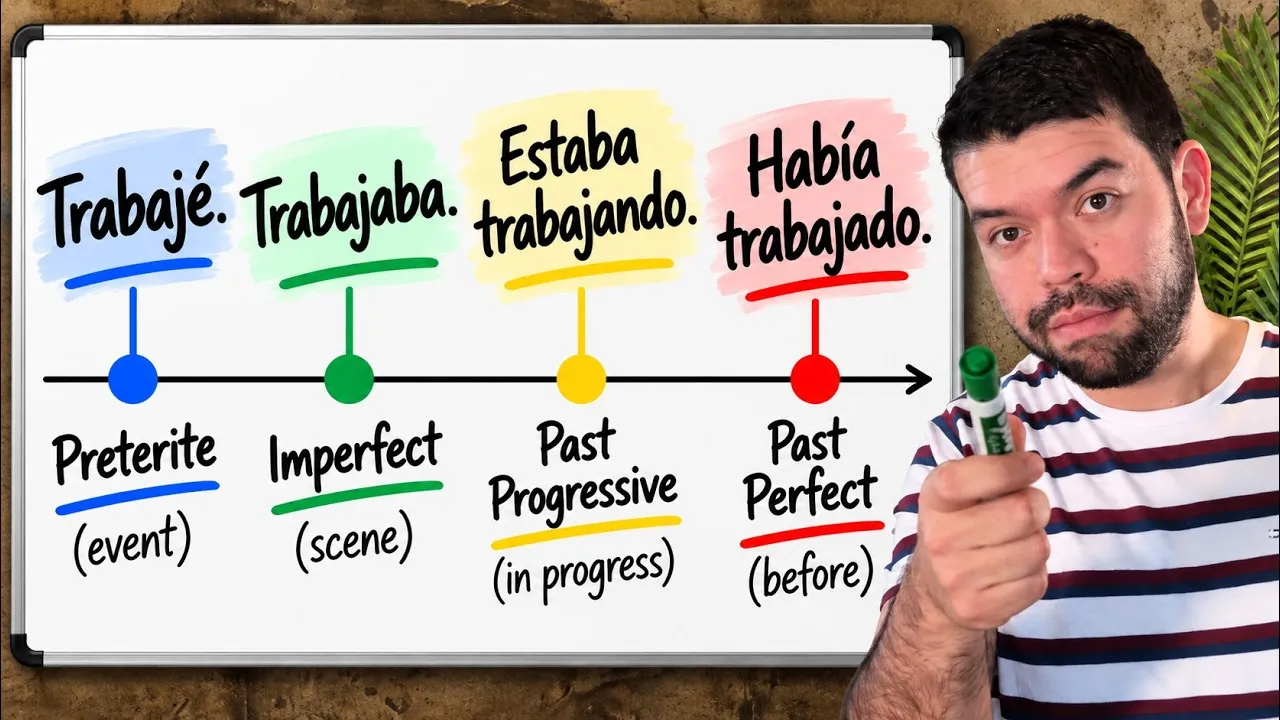
Trabajé. Trabajaba. Estaba trabajando. Había trabajado. Trabajara. Hubiera trabajado. Six ways to say that work happened in the past. English mostly gets by with "worked," "was working" and "had worked." So why does Spanish need so many?
Past tenses in Spanish. I know. This is where many learners panic and reach for a giant conjugation chart. No, stop. Chill. Today we're not memorizing endings. We're looking at the job each tense does in a story, because once you see the jobs, the choice gets much easier.
By the end of this, you'll have one simple map of every Spanish past tense, with one example for each that you can keep in your head.
1. The preterite: the event that moves the story forward
The pretérito (also called the pretérito indefinido or pretérito perfecto simple) tells you what happened. Something happened, and the story moves on.
- Ayer trabajé ocho horas. Yesterday I worked eight hours.
- Llegué a casa. I got home.
- Entré y cerré la puerta. I went in and closed the door.
Notice that each one is a step. First this, then this, then this. If you list what happened in order, you're using the preterite.
2. The imperfect: the scene around the events
The imperfecto paints the background: habits, descriptions, what things were like, what was going on.
- Cuando vivía en Madrid, trabajaba en un restaurante. When I lived in Madrid, I worked in a restaurant.
Pay attention here, because this is the central contrast of the whole lesson: the preterite gives you the events. The imperfect gives you the scene around them.
Imagine a movie. The camera follows a man:
- Llegué a casa. I got home. (event)
- Llovía. It was raining. (scene)
- La gente corría por la calle. People were running down the street. (scene)
- Entré y cerré la puerta. I went in and closed the door. (events)
The rain doesn't move the plot. It's the set. Getting home, going in and closing the door are what the character does on that set. If you want a whole lesson on why the imperfect is the storyteller's tense, read why the imperfect is used to tell stories.
Now look at this. The same verb can go either way:
- Viví en México dos años. I lived in Mexico for two years. A closed chapter, told as one block.
- Vivía en México cuando conocí a Ana. I was living in Mexico when I met Ana. Living in Mexico is the background; meeting Ana is the event.
The verb never decided the tense. The speaker did.
You've probably heard the rule "preterite for completed actions, imperfect for ongoing ones." It helps at first, but it breaks fast: two years in Mexico was long and ongoing, and it still takes the preterite in the first sentence. So don't memorize "completed vs. ongoing." Ask yourself a better question:
Am I moving the story forward, or placing you inside the scene?
This is the same question behind pairs like hubo vs. había: one reports that something happened, the other describes what was there.
3. The past progressive: the action caught mid-motion
The past progressive is estaba + gerund (-ando, -iendo). It zooms in on an action unfolding at a specific moment.
- Estaba cocinando cuando sonó el teléfono. I was cooking when the phone rang.
Here's the part that surprises English speakers. Compare:
- Trabajaba cuando llamaste. I was working when you called.
- Estaba trabajando cuando llamaste. I was working when you called.
Both are correct. English loves the progressive and uses it all the time. Spanish doesn't need it every time, because the imperfect already says "this was going on." Use estaba + gerund when you want to stress that the action was in progress right at that moment, like a freeze-frame. For a closer look at how estaba differs from estuvo, see estaba vs. estuvo.
4. The pluperfect: the past before the past
The pluscuamperfecto is había + past participle (-ado, -ido). It steps one layer further back: something that had already happened before another past moment.
- Cuando llegué, ya habían comido. When I arrived, they had already eaten.
- Nunca había visto la nieve antes del viaje. I had never seen snow before the trip.
Notice the little word ya (already). It shows up with the pluperfect a lot. Your arrival is the reference point; the eating was finished before it. A little sad, yes. Nobody saved you a plate.
5. The imperfect subjunctive: wishes and doubts, in the past
Now the subjunctive. Horrible, right? Relax. If you already know the present subjunctive, this is the same idea moved into the past.
- Quiero que vengas. I want you to come.
- Quería que vinieras. I wanted you to come.
When the main verb is in the past and expresses desire, a recommendation, emotion, doubt or necessity, the second verb often goes into the imperfect subjunctive. It also shows up in hypotheticals.
- No creía que fuera verdad. I didn't think it was true.
- Me recomendó que estudiara más. She recommended that I study more.
- Era necesario que saliéramos temprano. We needed to leave early.
The common forms end in -ra: vinieras, fuera, estudiara. You'll also see an -se version: vinieses, fuese, estudiase. It means the same thing and appears more in writing and in some regions. If you're starting out, use -ra. If the subjunctive itself still feels shaky, start with how to start using the Spanish subjunctive today.
6. The pluperfect subjunctive: what had happened, or what could have
The last one is hubiera + past participle. It's the pluperfect, but in subjunctive territory: emotion, doubt or wishes about something that had already happened.
- Me alegré de que hubieras venido. I was glad you had come.
- No sabía que hubieras terminado. I didn't know you had finished. (You'll also hear habías terminado here, and it's very common.)
- Quería que hubieras venido. I wished you had come.
And here's its most famous job, the unreal past. Something didn't happen, and you imagine what would have happened if it had:
- Si hubieras estudiado, habrías aprobado. If you had studied, you would have passed.
You didn't study. You didn't pass. Spanish lets you rewind and replay it anyway. Isn't it beautiful? It is. A little painful, but beautiful.
What about he comido?
An honest note before the recap. The present perfect (he comido, I have eaten) also talks about the past. How it splits the work with the preterite depends on the region. In much of Spain, you'll hear Hoy he comido paella for something that happened today. In much of Latin America, people more often say Hoy comí paella. Neither is wrong. These aren't two perfectly separated boxes, so if you're unsure, follow what you hear around you.
One scene, all the layers
Let me give you one short scene that uses the whole map:
Llegué a casa a las nueve. Llovía, y mi compañera estaba viendo una película. Ya había cenado. Me dijo que le habría gustado que llegara antes. "Si hubieras llamado, te habría esperado."
I got home at nine. It was raining, and my roommate was watching a movie. She had already had dinner. She told me she would have liked me to get home earlier. "If you had called, I would have waited for you."
Event, scene, action in progress, past before past, a past wish, an unreal past. Six jobs, one evening.
Recap
- Preterite moves the story forward: Ayer trabajé ocho horas.
- Imperfect sets the scene, habits and background: Cuando vivía en Madrid, trabajaba en un restaurante.
- Past progressive stresses an action unfolding at that moment: Estaba cocinando cuando sonó el teléfono.
- Pluperfect is the past before the past: Cuando llegué, ya habían comido.
- Imperfect subjunctive carries past wishes, doubts and emotions: Quería que vinieras.
- Pluperfect subjunctive is the had-happened version, and the unreal past: Si hubieras estudiado, habrías aprobado.
And if you only keep one line, keep this one: a tense is a way of framing the past, not just a way of saying when it happened.
Now it's your turn
Tell a three-sentence story about something that happened to you. Use one preterite, one imperfect and one pluperfect. For example: Llegué tarde a la oficina. Hacía mucho frío. Mi jefe ya había empezado la reunión. Write yours, then say it out loud.
Next lesson: put the first two tenses to work with estaba vs. estuvo, one of the most common places where the preterite and imperfect meet. Nos vemos.