How to Choose a Spanish Tutor: 6 Red Flags to Watch For
Real stories of bad Spanish tutors from our podcast, and the questions to ask yourself after a first class so you can spot a good one.
WorldsAcross team · November 14, 2026
In this article · 7 sections
“I booked a tutor to practice speaking. Halfway through the class, the tutor told me I sound like a child. Is that normal? Is it me?”
No. It's not you. And it's more common than you'd think. On the WorldsAcross Spanish Podcast, the hosts and their guest Vir, who leads the education team, read real stories that learners had posted online about their worst tutors. All of them say something about how to pick a better one.
First, a little perspective. Any time you learn from another person, you can get a bad one. The hosts compared it to finding a barber: one of them went to the same barber for 22 years, and it's been complicated ever since. You try, you learn, you go back to the one who gets it right. Here are the red flags they talked about, and what to do about each.
Red Flag 1: The Class Stops Being About Spanish
The first story was a classic. In a first class, the tutor asked the learner if he liked Latin American women, whether he'd ever dated one and what his type was. All with romantic piano music in the background. He tried to change the subject, then hung up and blocked her.
The hosts were clear: a good tutor builds trust, and that's part of the job. Warm, friendly, a little personal? Fine. But always with respect. Flirting is never part of a class. They also admitted it can go the other way: sometimes a learner mistakes a tutor's friendliness for something else. Either way, the rule is the same.
What to do: If a tutor makes you uncomfortable, you don't owe them politeness. End the class and report it wherever you booked.
Red Flag 2: You're Afraid to Open Your Mouth
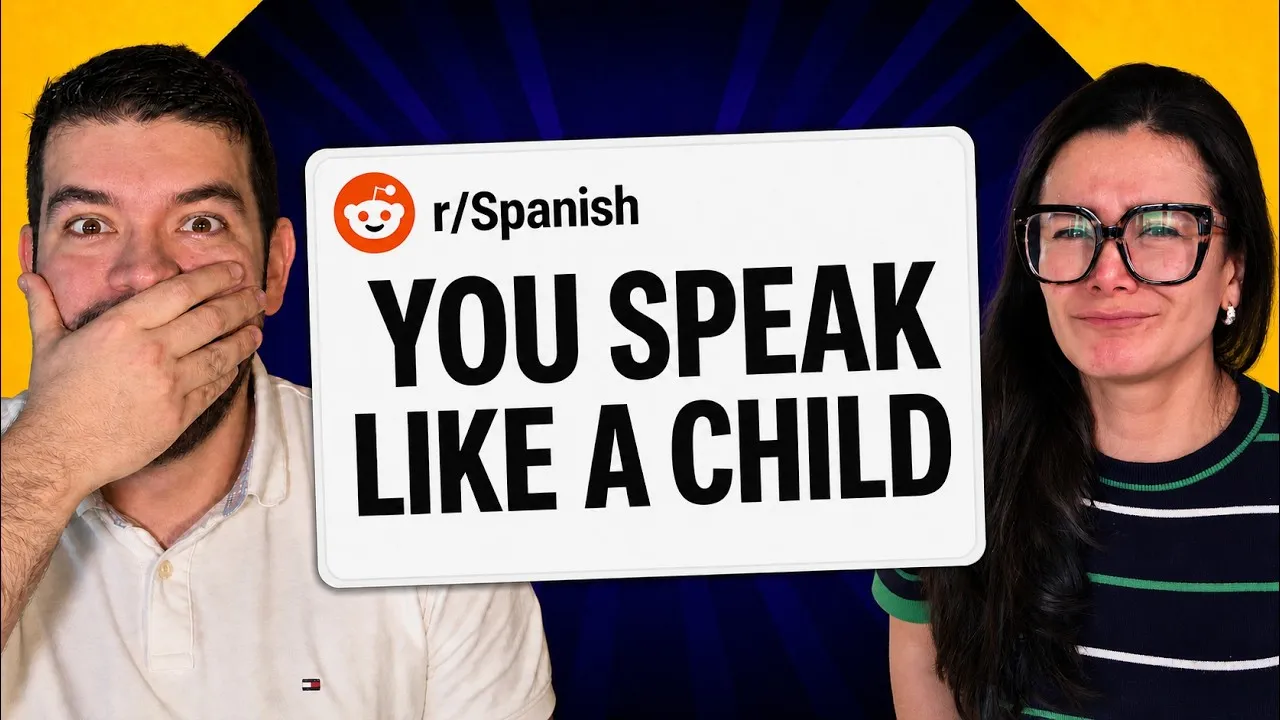
A B1 learner hired a tutor just to practice speaking. The tutor said they talked like a child. In another story, a tutor got so irritated with a learner's speaking that they said they'd jump out the window after the class.
Here the hosts didn't fully agree, and that's what made it interesting. One of them said that with some learners, after months of trust, a dramatic joke like that lands, and you both laugh. Humor also travels badly across cultures and screens. On a video call, in a language you're still learning, a joke can easily sound like an insult.
But nobody defended “you sound like a child.” You can correct someone, even bluntly, without making them feel small. As one host put it, nobody wins with that comment. Adults learning a language already feel exposed. Teachers call it the affective filter: when you feel judged, a wall goes up, and less Spanish gets through. One careless sentence can be the difference between someone quitting and someone keeping going.
So, depende. If you like direct correction, ask for it. Some learners love it. But direct is not the same as contemptuous. If you leave every class afraid to talk, that tutor isn't right for you.
Red Flag 3: They Never Asked Where You Are
A learner explained in her first message that she was Puerto Rican, hadn't used Spanish in ten years and wanted to start again from the basics. The tutor didn't read it. She talked to her as if she were conversational, sighed when she couldn't answer, and finally sent her off to practice with an app.
The hosts saw this as a communication problem more than anything else. A name like Jorge López doesn't mean someone grew up speaking Spanish at home. Plenty of second- and third-generation learners are starting fresh, and that's completely fine.
What to do: Be specific, and insist. You're paying for the class, so you get to steer it. A few sentences that help:
- Hace diez años que no hablo español. I haven't spoken Spanish in ten years.
- Quiero empezar desde lo básico. I want to start from the basics.
- ¿Puedes hablar más despacio, por favor? Can you speak more slowly, please?
- Prefiero que me corrijas al final de la clase. I'd rather you correct me at the end of the class.
- Hoy quiero practicar gramática, no solo conversar. Today I want to practice grammar, not just chat.
Red Flag 4: Your Spanish Is “Wrong” Because It's Not Their Spanish
One learner had answers marked wrong because they were natural Latin American Spanish, not the Spanish of Spain. The hosts didn't hold back: that's unacceptable. Spanish has many varieties, and a tutor should know them and encourage them, not defend their own.
A quick example. A group of friends in Mexico City is ustedes. In Madrid, the same friends are often vosotros. Both are correct. A good tutor can tell you where each one is used and help you pick one. A bad one just crosses it out. (If you're curious about the differences, start with regional vocabulary across Spanish-speaking countries.)
Red Flag 5: You're Paying, but Nobody's Teaching
This category had the most stories. A tutor promised grammar review and only ever chatted. Then came politics and religion, with annoyance whenever the learner disagreed. No homework corrections, and the phone came out during class. Another tutor spent the class telling stories about his own life, in English, jumping from topic to topic with no plan and no homework. The beginner felt like they were studying completely alone.
The hosts were fair about the other side, though. Back to the barber: if you sit down and the first thing you say is “So, how was your week?”, don't be surprised when you get the whole story. Some learners really do want conversation, and that's 100% valid. The problem is a mismatch between what you want and what you get.
What to do: Say what you came for, kindly and early. If it keeps drifting, say it again. Before you book, read the reviews and references. And afterwards, every bad class teaches you something about choosing the next one.
Red Flag 6: The Classroom Is a Moving Car
The last stories were about basic professional standards. A tutor who kept getting up and disappearing, and who finally taught a class while driving, with her family in the car. A tutor who was robbed on the street mid-class and told the learner to give him five minutes while he chased the thief. And one host remembered a tutor who taught four classes in one day from a hair salon, which might be the noisiest room on earth.
A class doesn't need a classroom. It needs a quiet place and a decent connection. Internet fails sometimes, for everyone. It just shouldn't be normal.
And the hosts turned it back on learners, too. Taking a class from traffic, the subway or your bed isn't great either. Respect goes both ways.
So How Do You Choose a Good One?
Pulling it together, the hosts' advice comes down to a few questions you can ask yourself after a first class:
- Did they ask about my level and my goal, or did they assume?
- When they corrected me, did I want to keep talking?
- Did they respect the Spanish I already have, wherever it's from?
- Did the class follow what I asked for?
- Was the tutor in a place where they could actually teach?
If most answers are no, move on. That's not rude. That's choosing. And if you're still deciding whether you need a tutor at all, we weighed both sides in do you really need a Spanish tutor, or can you handle it solo?
Your turn: write the one sentence in Spanish you'd say at the start of your next class. Hoy quiero… Today I want…
Want the full stories, the laughs and the hosts' disagreements? Watch the full episode on the WorldsAcross YouTube channel.