
How to Use Faltar in Spanish: Me Falta, Me Faltas
Me falta dinero, faltan dos minutos, me haces falta. Faltar puts what's missing in charge. Learn the one idea behind every use of the verb.
WorldsAcross team · November 13, 2026
In this article · 9 sections
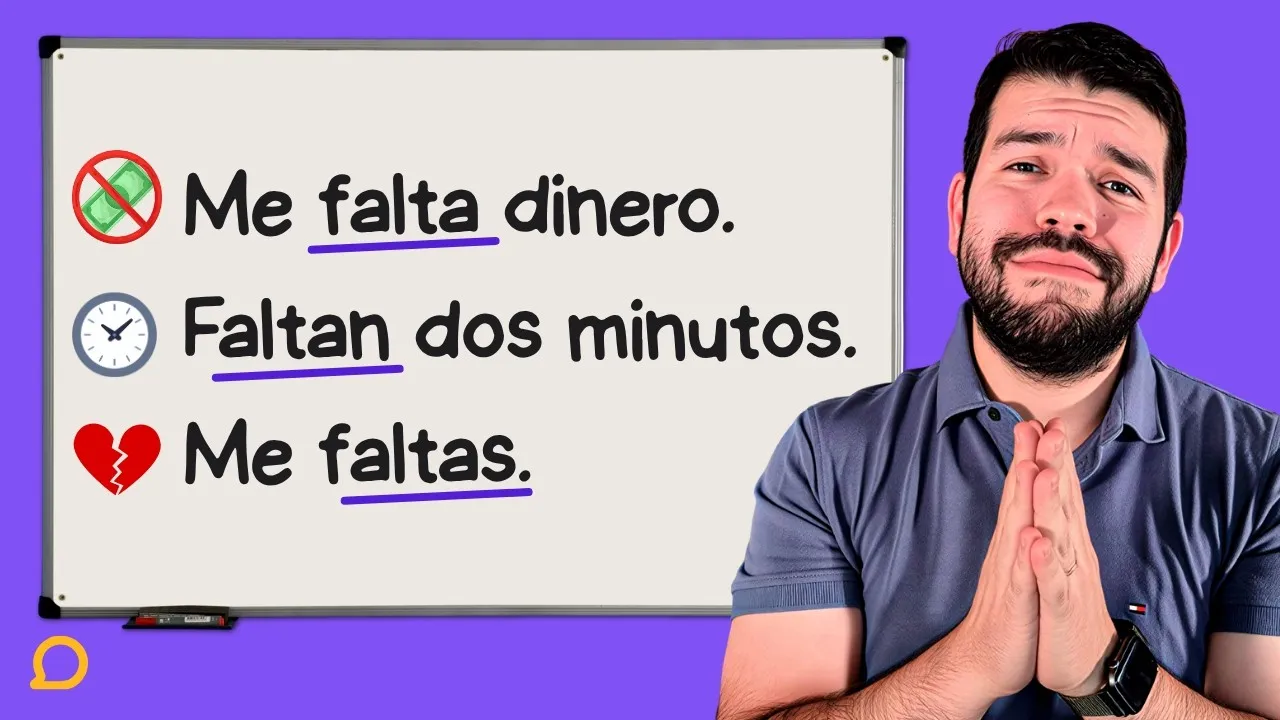
Me falta dinero. Faltan dos minutos. Me faltas. Same verb, three very different situations: money, time and a person you love.
This is where many learners get confused, because English thinks about missing one way and Spanish thinks about it completely differently. By the end of this article you'll know the main uses of faltar, why the sentence feels backwards, and the one mental model that connects all of it.
The core idea: something is absent
Faltar does not mean "I miss something." It means something is absent, or something is lacking. Spanish focuses on what is missing, not on the person experiencing it.
So don't ask the English question, "who is doing the missing?" Ask yourself the Spanish one: what is absent here? Once you ask that, all the uses start connecting.
Missing things
Let's start with a very real example, and a little sad. Me falta dinero. I'm short on money. You know that moment. The literal idea isn't "I miss money" (although, honestly, sometimes I do). It's "money is lacking to me."
- Me falta tiempo. I don't have enough time.
- Nos falta comida. We're short on food. Sad again, right?
- Le falta experiencia. He lacks experience.
- Nos falta práctica. We need more practice.
Notice the pattern. Me, te, le, nos, les show who experiences the absence. But the subject is dinero, tiempo, comida, experiencia: the thing that is missing. If that structure reminds you of gustar, good catch. Spanish has a whole family of verbs that organize the sentence this way. We dig into that logic in why we say things like lo que me faltaba.
Falta or faltan: the missing thing decides
So why is it sometimes falta and sometimes faltan? Look at this carefully:
- Me falta un dólar. I'm one dollar short.
- Me faltan diez dólares. I'm ten dollars short.
The thing that is missing controls the verb. One dollar, singular. Ten dollars, plural. Not the person.
- Falta un minuto. / Faltan cinco minutos. One minute left. / Five minutes left.
- Te falta una página. / Te faltan muchas páginas. You have one page to go. / You have a lot of pages to go.
Time that hasn't arrived yet
This is one of the most common uses. You're late, you look at your phone: ¡Faltan diez minutos! Ten minutes to go. Let's run.
- Faltan dos días para el examen. The exam is two days away.
- Falta una hora. There's one hour left.
Pay attention to that last one: falta una hora, not faltan, because there's one hour. Think about the logic. Those minutes, those days, are still missing. They haven't arrived yet. English counts what's left; Spanish sees what hasn't shown up.
Missing people
This is the emotional use, and my favorite. Me faltas. It usually translates as "I miss you." But literally? You are missing from me. From my life. A little dramatic, yeah, I know. That's the feeling.
You'll also hear it with hacer falta. The logic doesn't change: Spanish still focuses on the absence.
- Me haces falta. I miss you. (You're absent to me.)
- Nos haces falta aquí. We miss you here. We feel your absence.
- Me hace falta café. I need coffee. Always, right?
- Me hace falta dormir. I need to sleep.
Notice that hacer falta slides between "miss" and "need". With a person, it sounds like missing them. With coffee or sleep, it sounds like needing it. Honestly, those aren't two perfectly separated boxes: what you miss is often what you need. El café siempre hace falta. Coffee is always needed.
One more thing. For "I miss you," you'll also hear te extraño, very common in Latin America, and te echo de menos, very common in Spain. None of them is wrong. Me haces falta and me faltas just say it from the absence's point of view.
Why this feels backwards
Because we all try to translate directly. You think "I miss money," so you look for the person doing the action. Spanish isn't asking who acts. It's asking what is absent.
That's why two mistakes come up in classes all the time:
- Yo falto dinero. Not quite. What's missing? Money, sadly. So money is the subject: Me falta dinero.
- Thinking me is the subject. It isn't. The real subject is dinero, tiempo, tus amigos or tú: the thing or person that is missing.
It happens to everyone who comes from English. It's not a you problem. It's a perspective problem, and perspective you can train.
One Sunday night, all the uses
Imagine it's Sunday night and your exam is Monday morning. Spanish can tell the whole scene with one verb:
- Faltan doce horas para el examen. The exam is twelve hours away.
- Te faltan dos capítulos del libro. You still have two chapters of the book to go.
- Te falta tiempo. You don't have enough time.
- Te hace falta café. You need coffee.
- Tu mejor amiga está de viaje, y te hace falta. Your best friend is away on a trip, and you miss her.
Time remaining, missing things, needing something, missing someone. Different situations, same logic. Isn't it beautiful? It is.
We're leaving out a few edges today, like faltar a clase (to miss class) and the expression ¡lo que me faltaba! (that's all I needed). The core picture comes first.
Recap
- Me falta dinero. Money is lacking: the missing thing is the subject.
- Falta or faltan depends on the missing thing: falta un minuto, faltan dos minutos.
- Me faltas and me haces falta: you are absent to me. Don't ask who is missing something. Ask what is absent.
Your turn
Write one sentence with faltar. It can be something you need, something you don't have, someone you miss or time remaining. Then check it: is the missing thing your subject?
Profe Juan explains every one of these examples in the full lesson on Learn Spanish From Scratch. Watch it above.