How to Use Poner in Spanish: Put, Put On, Become
Pon la mesa, ponte la chaqueta, se puso nervioso, pon música. Poner isn't just put. Learn the one idea behind every use: something lands in a new place.
WorldsAcross team · November 13, 2026
In this article · 9 sections
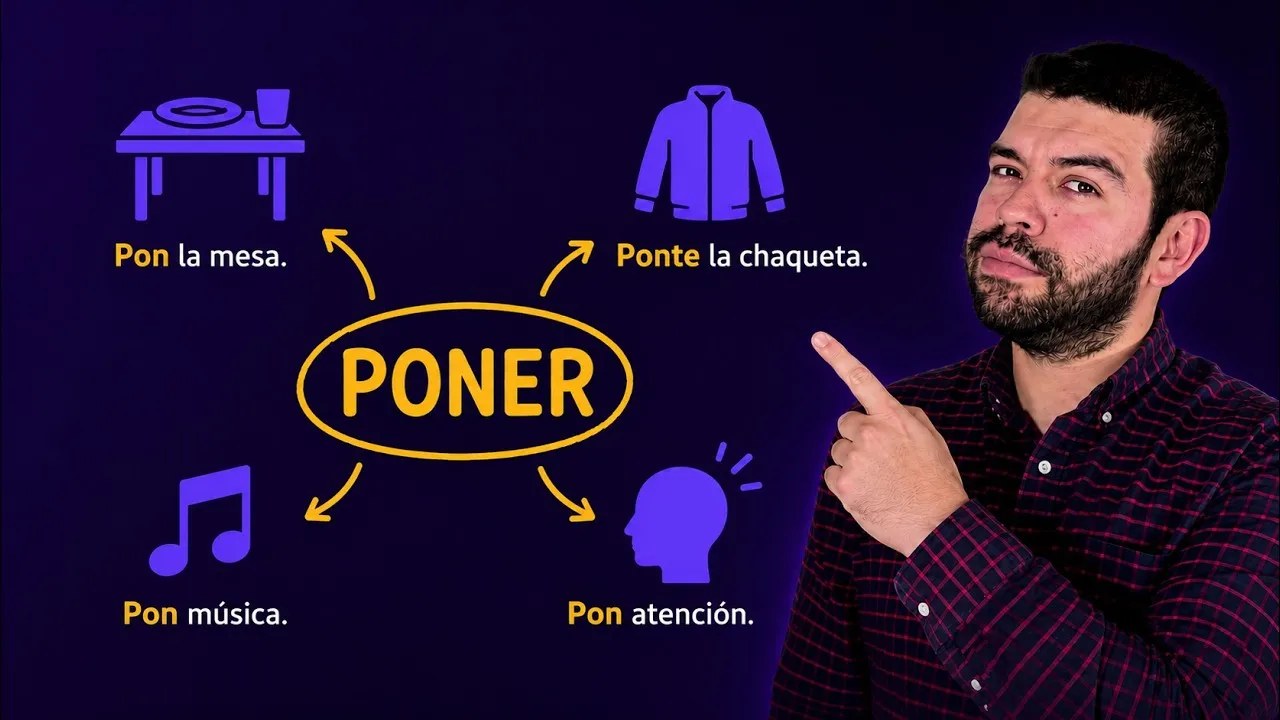
Pon la mesa. Ponte la chaqueta. Se puso nervioso. Pon música. Pon atención. Same verb, poner, five times. Five very different situations.
Here's what usually happens. You learn that poner means "to put." Great, easy. Then you hear poner música, poner atención and ponerse nervioso, and "put" stops working. Put music? Put attention? Put yourself nervous? This is where many learners decide poner is just a random verb with ten meanings to memorize. Tranquilo. It isn't.
By the end of this article you'll have one picture that connects all five uses, and one question to ask every time you hear poner.
The core idea: something lands in a new position
Let me illustrate the core idea first. Poner means placing something into a new position or a new state. Sometimes that something is an object. Sometimes it's you, placed into a new condition. Sometimes it's music or a movie, placed into motion so it starts.
So don't memorize poner = put. Ask yourself one question: what is being placed, and where does it end up?
1. Placing an object
Let's start with the literal meaning, the one you already know.
- Pon el libro aquí. Put the book here.
- Puse las llaves en la mochila. I put the keys in the backpack.
- ¿Dónde pongo esto? Where do I put this?
- Pon la mesa. Set the table.
Look at that last one. English says "set," but Spanish just sees what you're doing: you place the plates, the glasses and the silverware on the table. Objects moving into position. Same picture as the keys.
Notice the forms, too, because poner is irregular. Pongo is the present (I put), and puse is the past (I put). These two show up constantly, so they're worth saying out loud a few times.
2. Ponerse: placing something on yourself
Ponte la chaqueta. Put your jacket on.
Pay attention here. Now the jacket lands on you. That's why Spanish adds the se (here, te): the action comes back to the person doing it. You place the jacket onto yourself.
- Me pongo los zapatos. I put on my shoes.
- Ponte la chaqueta, hace frío. Put your jacket on, it's cold.
If that reflexive pattern still feels slippery, we break it down in how to know if a verb is reflexive.
3. Ponerse + a state: became
This is the one that surprises people. Se puso nervioso. He got nervous.
- Me puse triste. I got sad.
- Se puso feliz. She got happy.
- Nos pusimos de pie. We stood up.
Nothing physical moved. Nobody put anything anywhere. But the person entered a new state. A minute ago he was calm; now he's nervous. Spanish sees that as placing yourself into a new condition. English reaches for "got" or "became." Spanish keeps returning to poner.
Nos pusimos de pie is a nice bridge between the two ideas: your body ends up in a new position, standing.
4. Making something start
Now imagine you're at home and you want some music.
- Pon música. Put some music on.
- Voy a poner una película. I'm going to put a movie on.
- Pon la tele. Turn on the TV.
- ¿Puedes poner esta canción? Can you play this song?
English often says "play" here. Spanish doesn't think "play." The idea is closer to the English "put the music on": you place the song into motion, and it starts. Once you see it that way, pon la tele stops sounding strange.
5. Poner atención: directing your attention
- Tienes que poner más atención. You need to pay more attention.
- No puso atención en clase. He didn't pay attention in class.
English pays attention, like it's money. Spanish places it. You take your attention and put it somewhere: on the teacher, on the road, on the person talking to you.
To be honest about the edges: you'll also hear prestar atención a lot, and it means the same thing. Presta atención. Pay attention. Both are correct. If you're unsure, either one will be understood. Just know that when you hear poner atención, it's the same placing idea.
One Friday night, all the uses
Let's put everything into one scene. It's Friday night and you're getting ready to go out.
- Pongo música mientras me preparo. I put music on while I get ready. Something starts.
- Me pongo la chaqueta negra. I put on my black jacket. Onto yourself.
- Pongo las llaves en el bolsillo. I put my keys in my pocket. An object, placed.
- Mi amigo llega tarde y me pongo nervioso. My friend is late and I get nervous. A new state.
- En la cena, mi amiga cuenta algo importante y pongo atención. At dinner, my friend shares something important and I pay attention. Attention, directed.
Five English verbs: put on, put, get, pay, play. One Spanish picture. Isn't it beautiful? It is.
We're leaving other uses of poner, like ponerse a + infinitive (to start doing something), for another day. Get the picture first, and those get much easier to decode.
Recap
- An object lands somewhere: Pon el libro aquí. Pon la mesa. Something lands on you: Ponte la chaqueta.
- You land in a new state: Se puso nervioso. Nos pusimos de pie. Something starts: Pon música.
- Your attention lands somewhere: Pon atención. Don't memorize poner = put. Ask: what is being placed, and where does it end up?
If you like verbs where one Spanish idea covers a pile of English translations, read next about how to use sacar, where something comes out instead of landing. And for a verb English splits the other way, see salir, irse and dejar: three ways to say leave.
Your turn
Write one sentence with poner about your day: something you put somewhere, something you put on, how you got, or something you put on to watch or listen to. Then ask yourself: what was placed, and where did it end up?
Profe Juan explains every one of these uses in the full lesson on Learn Spanish From Scratch. Watch it above.