How to Use Dejar in Spanish: Leave, Let, Stop
Dejé las llaves, déjame hablar, dejó de fumar, me dejó agotado. Dejar isn't just leave. Learn the one idea behind every use, and the tiny de that flips it.
WorldsAcross team · November 13, 2026
In this article · 9 sections
Dejé las llaves aquí. Déjame hablar. Dejó de fumar. La noticia me dejó preocupado. Same verb, dejar, four times. In English, that's leave, let, stop and... made me worried?
Here's what usually happens. You learn that dejar means "to leave," and it works fine for keys and phones. Then you hear Mi mamá no me deja salir and Dejé de trabajar a las seis, and "leave" falls apart. My mom doesn't leave me go out? I left of working? This is where many learners decide dejar is four different verbs that happen to share a spelling. Tranquilo. It's one verb with one idea.
By the end of this article you'll have that idea, the tiny word that flips its meaning, and one question to ask every time you hear dejar.
The core idea: you let go
Let me illustrate the core idea first. With dejar, you stop holding, controlling or continuing something, and you let it stay, happen or end. You let go of an object, and it stays where it is. You let go of control, and someone else gets to act. You let go of an action, and it ends. You let go of a person, and they're left in a new state.
So don't memorize dejar = leave. Ask yourself one question: what am I letting go of: an object, control, an action, or a person in a new state?
1. Leaving something somewhere
This is the meaning you probably already know, and we cover it next to salir and irse in salir, irse and dejar: three ways to say leave. Quick refresher:
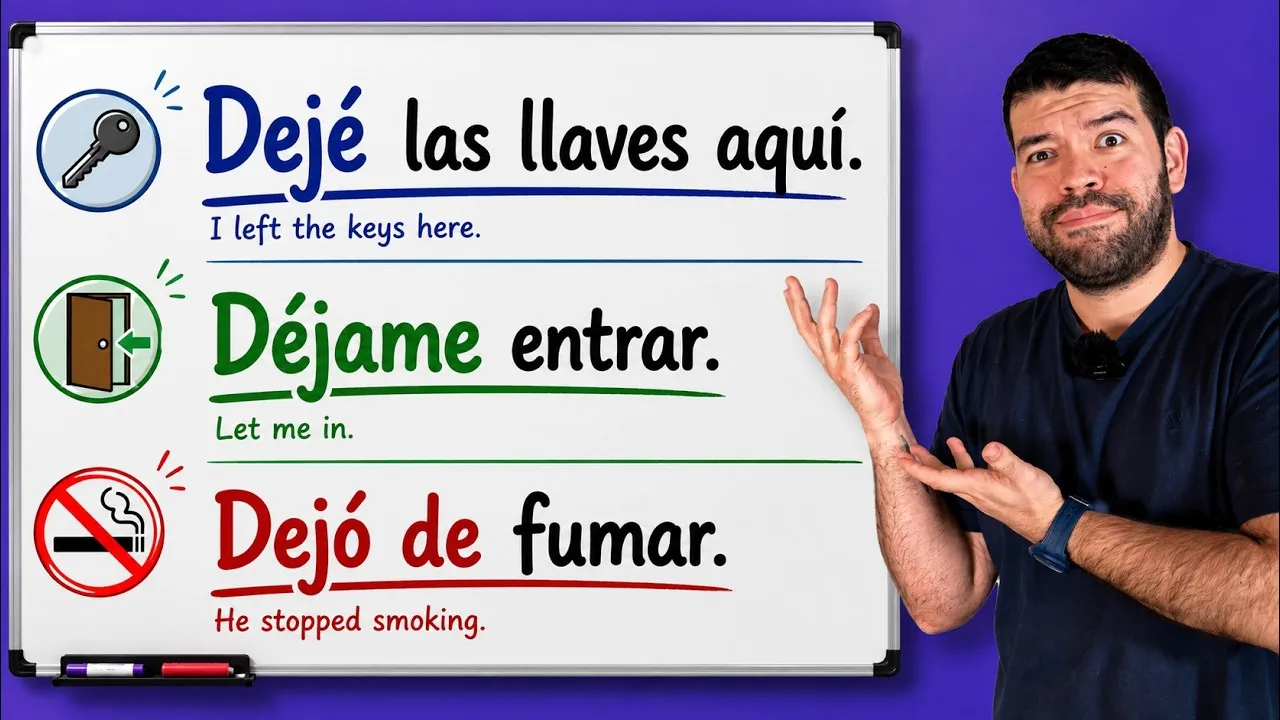
- Dejé las llaves aquí. I left the keys here.
- Dejé el teléfono en casa. I left my phone at home.
- ¿Puedes dejar la mochila aquí? Can you leave the backpack here?
- ¿Dónde dejaste el coche? Where did you park the car?
Look at that last one. English says "park." Spanish just sees what happened: you let go of the car, and it stayed somewhere. Same picture as the keys.
2. Letting someone do something
Now you let go of control. The pattern is dejar + person + infinitive.
- Déjame entrar. Let me in.
- Déjame hablar. Let me speak.
- Mi mamá no me deja salir. My mom doesn't let me go out.
- ¿Me dejas usar tu teléfono? Can I use your phone? (Literally: do you let me use your phone?)
- Te dejo elegir. I'll let you choose.
- Nos dejaron pasar. They let us through.
Notice what's happening. You could stop the other person, but you don't. You step back, and the action happens. That's still letting go.
Pay attention to the spelling, too. Deja has no accent, but déjame does. When you attach me to the end, the stress stays on de, and the written accent is what keeps it there.
3. Stopping an action: dejar de
Now add one small word, de, and you're letting go of an action. The pattern is dejar de + infinitive, and it means to stop doing something.
- Dejó de fumar. He quit smoking.
- Dejé de trabajar a las seis. I stopped working at six.
- ¡Deja de gritar! Stop yelling!
- Nunca dejó de intentarlo. She never stopped trying.
Learn dejar de + action as one unit, not as dejar plus a random preposition. When you hear dejar de, your brain should already be waiting for an action that ends. Let's pretend I was a smoker, which I'm not: Dejé de fumar means the cigarettes are behind me. I let the habit go.
4. Leaving someone in a state
This is the one that surprises people. The pattern is dejar + person or thing + state.
- Me dejó solo. He left me alone.
- Nos dejaron esperando. They left us waiting.
- La noticia me dejó preocupado. The news left me worried.
- El viaje me dejó agotado. The trip left me exhausted.
- Dejaron la puerta abierta. They left the door open.
- Me dejó sorprendido. It left me surprised.
- La dejó sin palabras. It left her speechless.
Here, something happens and then lets go of you, and you stay in a condition. The news is over, but you're still worried. The trip is over, but you're still exhausted. English actually does this too ("left me speechless"), so this one is easier than it looks. The trick is to notice it in Spanish, because it shows up constantly.
The trap: one tiny de
This is where many learners get stuck. Compare these two:
- Me dejó hablar. He let me speak.
- Dejó de hablarme. He stopped speaking to me.
Same verb, same person, almost the same words. Opposite situations. In the first, he gave you the floor. In the second, he cut you off completely. The only real difference is that tiny de.
You'll also hear Me dejó de hablar, with the me moved to the front. It means the same thing as Dejó de hablarme, and it's very common in everyday speech. What matters is the de: with it, something stops. Without it, someone is allowed.
So when you hear dejar + infinitive, listen for that de before you decide what happened.
One roommate, four uses
Let's put everything into one scene. Imagine your roommate, Diego, on a Saturday morning.
- Diego dejó sus zapatos en la entrada. Diego left his shoes by the door. An object stays.
- Le pregunté: "¿Me dejas usar tu cargador?" y me dejó usarlo. I asked, "Can I use your charger?" and he let me. Control, let go.
- Después le dije: "¡Deja de cantar en la ducha!" Pero no dejó de cantar. Then I told him, "Stop singing in the shower!" But he didn't stop. An action that should have ended.
- Al final se fue y dejó la puerta abierta. Eso me dejó preocupado. In the end he left and left the door open. That left me worried. A thing and a person, each in a new state.
Four English verbs: leave, let, stop, and leave-in-a-state. One Spanish picture: letting go. Isn't it beautiful? It is.
Notice se fue in that last line. Diego going away is irse, not dejar. Dejar is about what he left behind: an open door and a worried roommate.
Recap
- Let go of an object, and it stays: Dejé las llaves aquí. ¿Dónde dejaste el coche? Let go of control, and someone acts: Déjame entrar. Te dejo elegir.
- Let go of an action, and it ends: Dejó de fumar. ¡Deja de gritar! Let go of a person, and they stay in a state: El viaje me dejó agotado. Watch the tiny de: Me dejó hablar is not Dejó de hablarme.
- Don't memorize dejar = leave. Ask: what am I letting go of: an object, control, an action, or a person in a new state?
Your turn
Write one sentence with dejar about your week. Something you left somewhere, something someone let you do, something you stopped doing, or something that left you tired, happy or surprised. Then ask yourself: what was let go of?
If you like verbs where one Spanish idea covers a pile of English translations, read next about how to use poner, where something lands in a new place instead of being let go. Profe Juan walks through all four uses of dejar in the full lesson on Learn Spanish From Scratch. Watch it above.