
How to use the infinitive, gerund and participle in Spanish?
Learn how to use the Spanish infinitive, gerund, and participle with ease. Master verb forms to speak more naturally and clearly in any situation.
WorldsAcross team · June 26, 2025
In this article · 5 sections
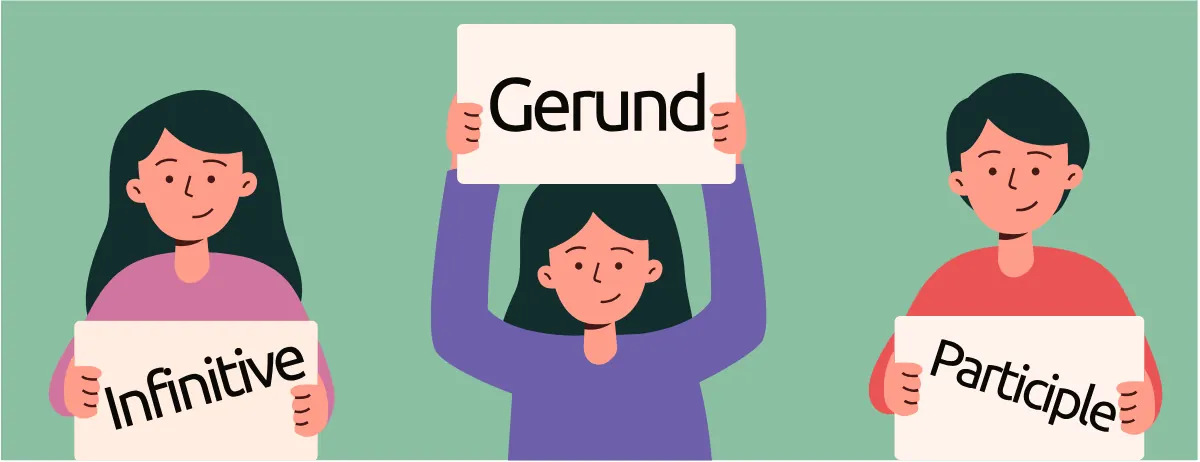
Sometimes they appear in their pure form, other times in action, and sometimes their role has already ended. Ready to discover how to use the infinitive, gerund, and past participle in Spanish?
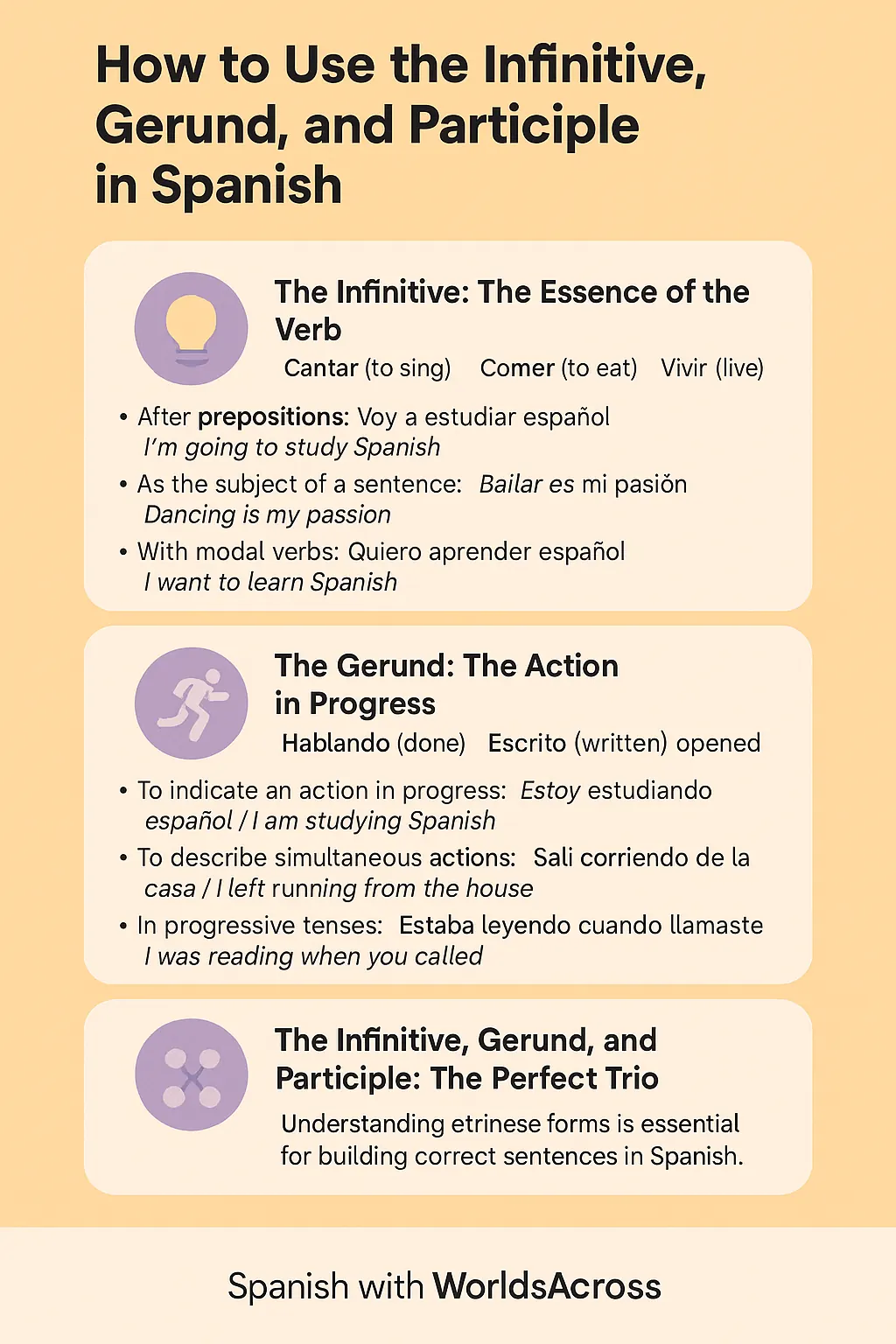
The Infinitive: The Essence of the Verb
Think of the infinitive as the official introduction of a verb. It’s its natural, unconjugated form — like an actor waiting backstage before stepping into the spotlight.
Examples:
-
Cantar (to sing)
-
Comer (to eat)
-
Vivir (to live)
When to use the infinitive:
-
After prepositions: Voy a estudiar español / I'm going to study Spanish.
-
As the subject of a sentence: Bailar es mi pasión / Dancing is my passion.
-
With modal verbs: Quiero aprender español / I want to learn Spanish.
In Spanish, unlike English, the infinitive can function as a noun:
El viajar enseña mucho / Traveling teaches a lot.
The Gerund: The Action in Progress
If the infinitive is the actor waiting for their turn, the gerund is the one already performing on stage. It’s formed with -ando for -ar verbs and -iendo for -er or -ir verbs:
-
Hablando (speaking)
-
Corriendo (running)
-
Escribiendo (writing)
When to use the gerund:
-
To indicate an action in progress: Estoy estudiando español / I am studying Spanish.
-
To describe simultaneous actions: Salí corriendo de la casa / I left running from the house.
-
In progressive tenses: Estaba leyendo cuando llamaste / I was reading when you called.
Note: In Spanish, the gerund is not used as a noun. Do not say Comiendo es bueno. The correct form is Comer es bueno (Eating is good).
The Past Participle: The Completed Action
The participle is like the actor who has finished their scene but leaves a lasting impression. It’s used to form compound tenses and also works as an adjective.
Examples:
-
Hecho (done)
-
Escrito (written)
-
Abierto (opened)
When to use the participle:
-
In compound tenses: He aprendido español / I have learned Spanish.
-
To describe a state: La puerta está cerrada / The door is closed.
-
In passive voice: El libro fue escrito por Cervantes / The book was written by Cervantes.
Be aware that some participles are irregular, like dicho (said) and visto (seen), and need to be memorized.
The Infinitive, Gerund, and Participle: The Perfect Trio
Understanding how to use the infinitive, gerund, and participle is essential for building correct sentences in Spanish.
This trio works like a well-rehearsed cast:
-
The infinitive is the dreamer, thinking about the action without doing it (bailar, comer).
-
The gerund is in the middle of the action (bailando, comiendo).
-
The participle is the experienced one, having already completed the task (bailado, comido).
Examples:
-
Infinitive: Me gusta aprender español / I like to learn Spanish.
-
Gerund: Estoy aprendiendo español / I am learning Spanish.
-
Participle: He aprendido español / I have learned Spanish.
If you're unsure which to use, think about whether the action is general (infinitive), in progress (gerund), or already completed (participle).
Mastering These Three Forms Is Essential
Mastering how to use the infinitive, gerund, and participle will help you sound more natural in Spanish. Every word has its role, and knowing when to use each verb form will help you express yourself more clearly and confidently.
Don’t worry if you get confused at first. With practice and patience, Spanish will become a language you not only understand, but truly enjoy using.
And remember, at WorldsAcross there's always someone ready to support your learning journey. Keep going — the stage is yours.