Lo vs. Le in Spanish: Which One and Why
Lo receives the action, le receives something else. Learn the rule, why parts of Spain say le vi, and a safe default that works everywhere.
WorldsAcross team · November 13, 2026
In this article · 9 sections
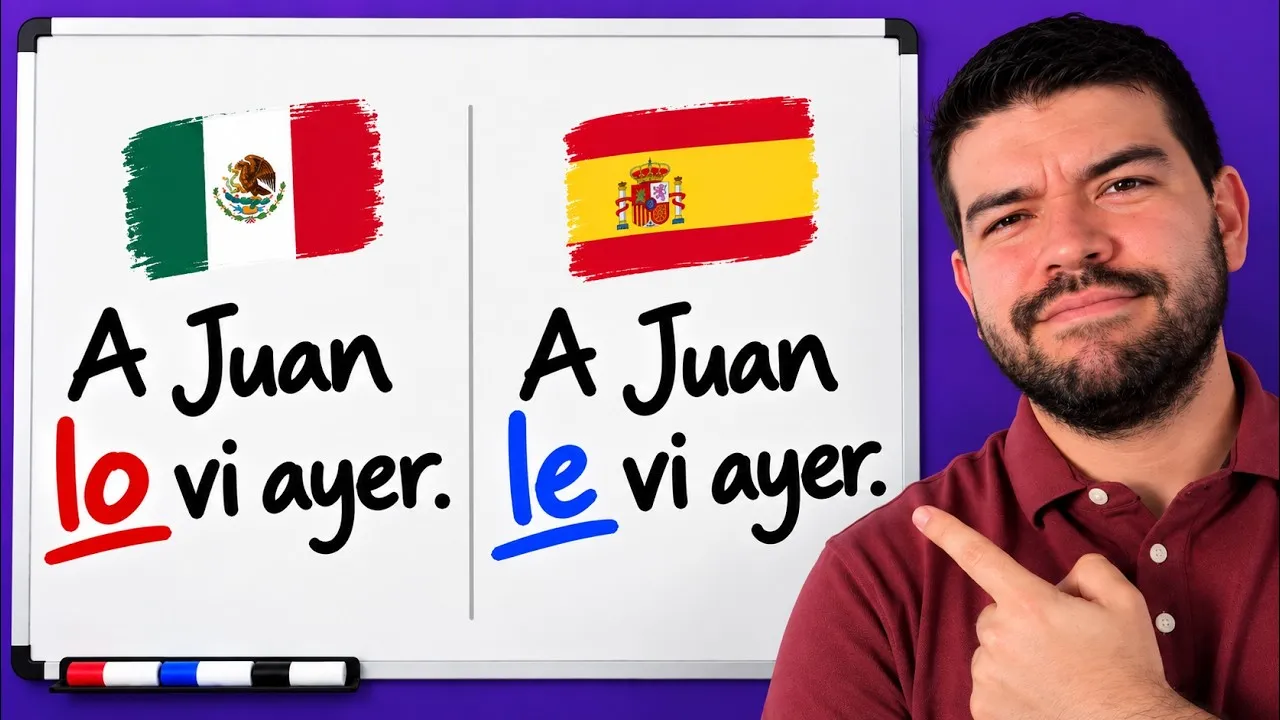
Lo vi ayer. Le vi ayer. Same man, same verb, same yesterday. If you learned your Spanish in Mexico, the first one probably sounds right. Travel to parts of Spain, and the second one sounds completely normal too.
So which one is correct? Before we get to Spain and Mexico, you need one very simple rule. Once that rule is clear, the regional difference stops looking like chaos and starts looking like a pattern you can recognize. Pronouns, I know. Grab a pencil anyway. This one is more interesting than it looks.
The rule in one line
Lo receives the action. Le receives something else.
Don't memorize a chart. Ask yourself one question: what is the verb doing to this person or thing? If the verb lands on it directly, it's the direct object, and in the basic system you replace it with lo (masculine) or la (feminine).
Let me illustrate the core idea first. Veo a Juan. I see Juan. Juan is the person being seen. He receives the action directly. Replace a Juan and you get Lo veo. I see him.
- Llamé a Juan. → Lo llamé. I called Juan. I called him.
- Invité a Juan. → Lo invité. I invited Juan. I invited him.
- Veo a María. → La veo. I see María. I see her.
Same pattern every time. Juan is the direct target of llamar or invitar. Simple, right?
And it works the same with things. Compré el libro. I bought the book. What did I buy? The book. So: Lo compré. I bought it. Now Compré la camisa. Lo or la? Exactly: La compré. Lo and la replace whatever the verb affects directly, a person or a thing.
The personal a is not a trap door
Pay attention here, because this is where many learners get stuck. Look at Vi a Carlos. I saw Carlos. Spanish puts a little a before a person who is a direct object. Learners see that a and think: maybe Carlos is the indirect object. No, no, no.
The a doesn't change his job. Carlos is still the person I saw. He's still the one the verb lands on. So: Lo vi. I saw him. And Vi a Laura becomes La vi. I saw her. If that little a keeps tripping you up, we have a whole post on verbs that use the preposition a.
Where le does its normal job
Le absolutely belongs in Spanish. It just normally has a different job. Look at this:
Di el libro a Juan. I gave the book to Juan. What did I give? The book. That's the direct object, the thing the verb moves. But who received it? Juan. So Spanish says Le di el libro. I gave him the book. Here le means something like "to him" or "to her".
- Mandé un mensaje a Ana. → Le mandé un mensaje. I sent Ana a message. I sent her a message.
- Conté la historia a Pedro. → Le conté la historia. I told Pedro the story. I told him the story.
To whom? To Ana. To Pedro. That's le's everyday job. Now compare the two side by side:
- Lo vi. I saw him. He's what I saw.
- Le di el libro. I gave him the book. He receives the book.
We're not going deep into indirect objects today. If you want more practice with them, read how to use le and les in conversations. For now, keep this one contrast in your pocket.
So why do so many native speakers say le vi?
If the rule is that clean, why will you hear le vi from perfectly fluent speakers? Welcome to leísmo.
In parts of Spain, especially when the direct object is a man, you'll commonly hear:
- Le vi ayer. I saw him yesterday.
- Le llamé esta mañana. I called him this morning.
- Le conozco muy bien. I know him very well.
The basic system would give you lo vi, lo llamé, lo conozco, and those forms are completely normal and correct. Using le for a male person as a direct object is called leísmo. And here's the important part: this specific type, le for one male person, is accepted in standard Spanish.
So if someone in Spain says Le vi ayer, don't assume they picked the wrong pronoun. You're hearing a real regional pattern. In Mexico and much of Latin America, the most natural choice is generally Lo vi ayer. That's why two native speakers can disagree about what sounds natural without either one struggling to understand the other.
Where leísmo stops
One important limit, so you don't over-generalize. Hearing le vi does not mean Spain uses le for every direct object.
- With a thing: Compré el coche. I bought the car. The normal form is Lo compré, not le compré, if you mean "I bought it."
- With a woman: Vi a María. The general standard form is La vi.
The widely accepted leísmo is narrow: le for a single male person. That's much smaller than "Spain uses le instead of lo." And it explains why Spain and Mexico can give you two different answers to what looks like the same simple sentence.
One scene, two maps
Imagine you run into Juan at the supermarket and give him back the book you borrowed. Here's how it might sound in Mexico City:
Ayer vi a Juan en el supermercado. Lo vi en la fila de la caja. Le di el libro.
Yesterday I saw Juan at the supermarket. I saw him in the checkout line. I gave him the book.
And here's how it might sound in Madrid:
Ayer vi a Juan en el supermercado. Le vi en la fila de la caja. Le di el libro.
Notice what moved and what didn't. Lo vi became le vi, because Juan is a man and that's the leísta pattern. But Le di el libro is the same in both cities. Juan receives the book everywhere.
The safe default
If you're unsure, follow the basic distinction. Direct object: lo and la. Indirect object: le.
- Vi a Juan. → Lo vi. I saw Juan. I saw him.
- Vi a María. → La vi. I saw María. I saw her.
- Di un regalo a Juan. → Le di un regalo. I gave Juan a gift. I gave him a gift.
That system works extremely well across the Spanish-speaking world. Then, when you hear le vi from a speaker in Spain, you can recognize it for what it is. You don't need to rebuild your whole pronoun system.
Recap
- Ask what the verb does to the person or thing. Receives the action directly: lo or la.
- The personal a doesn't make anyone indirect. Vi a Carlos is still Lo vi.
- Le for a male person (le vi) is leísmo: a real, accepted pattern in parts of Spain, not a mistake. Lo receives the action. Le receives something else.
Your turn
How would you replace Juan in this sentence? Vi a Juan en el supermercado. Say it out loud with lo or le, and then ask yourself where you learned your Spanish. Both answers can be right.
Want to hear Profe Juan walk through every example? Watch the full lesson above on Learn Spanish From Scratch.