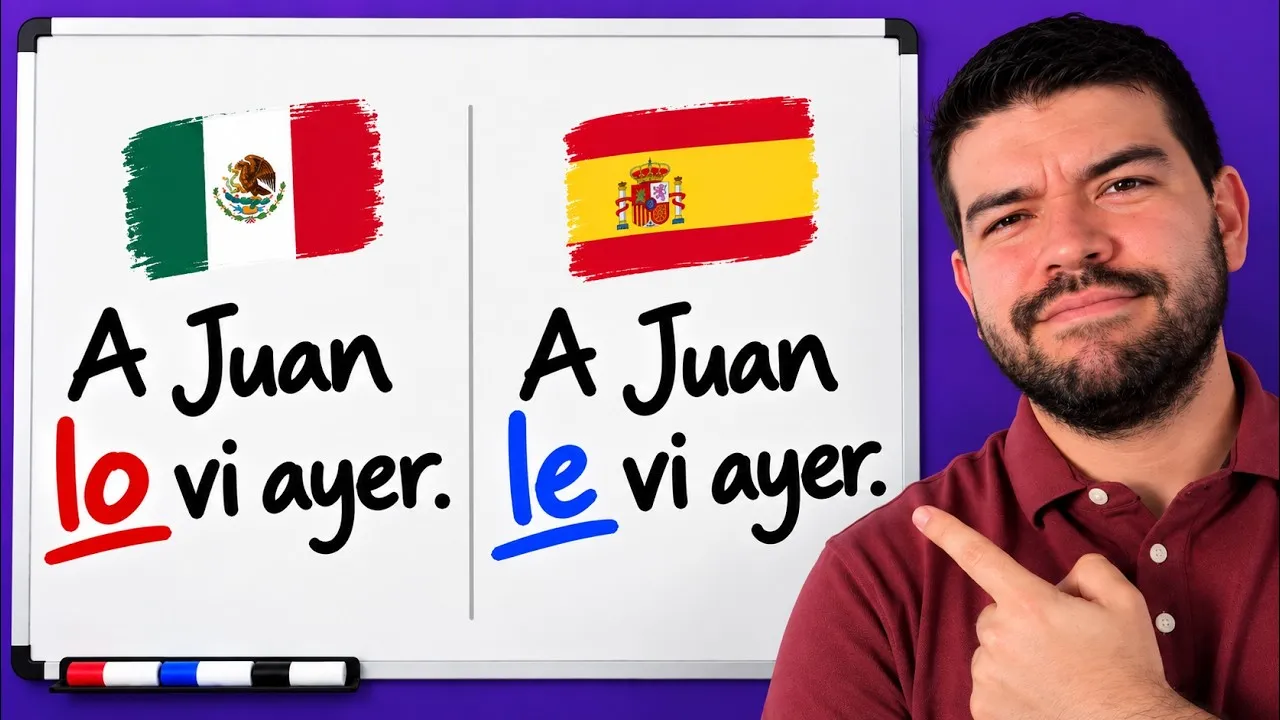
Ver vs Mirar, Oír vs Escuchar: Spanish Perception Verbs
Te vi entrar, la oí cantar: how ver, mirar, oír, escuchar and notar work, and why the second verb stays in the infinitive.
WorldsAcross team · November 14, 2026
In this article · 9 sections
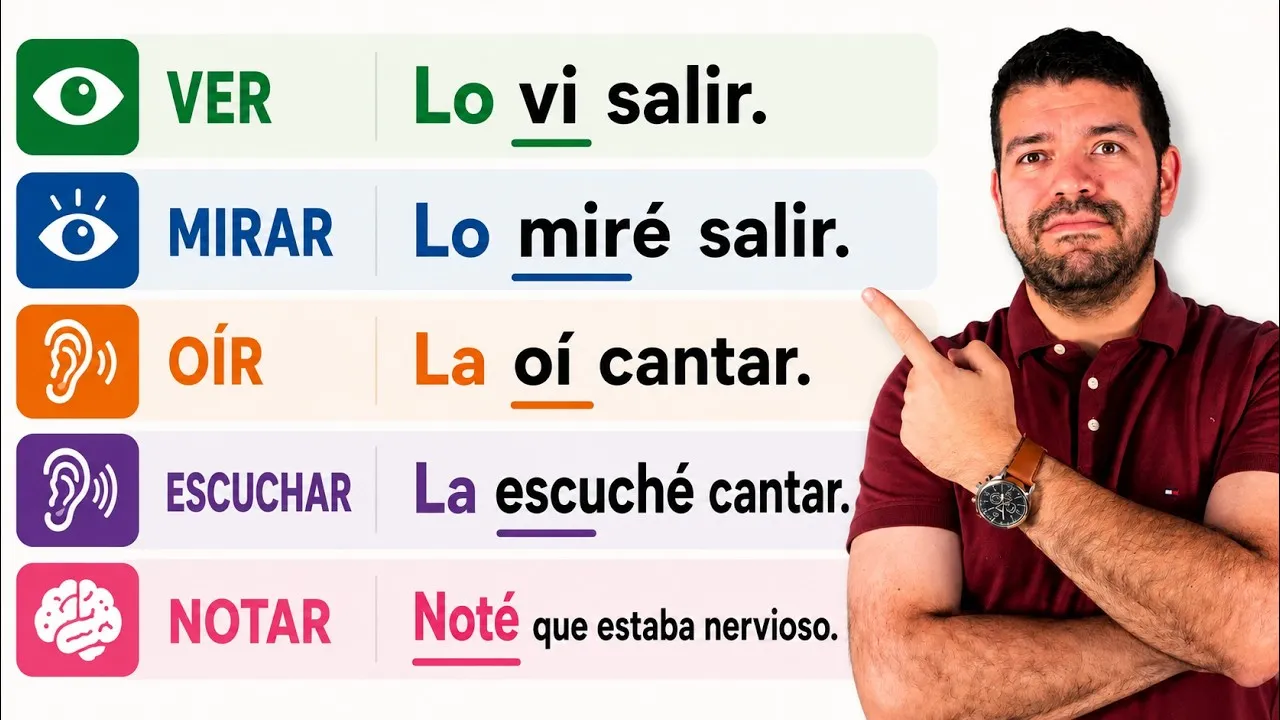
Te vi entrar. La oí cantar. Noté que estabas nervioso. Three short Spanish sentences, and each one packs a whole event inside it: someone walking in, someone singing, someone looking a little tense.
In English you'd say "I saw you come in" and never think twice. In Spanish, many learners freeze right there. Is it vi or miré? Do I conjugate entrar? Where does the te go? This is where a lot of people get stuck, and it's completely normal.
By the end of this lesson, you'll have one simple picture for ver, mirar, oír, escuchar and notar, plus the structure that makes sentences like lo vi salir feel easy.
The question to ask yourself
Don't memorize ver = see and oír = hear. Ask yourself one question: did it happen to me, or did I choose to do it?
English mixes these up all the time. Spanish sees two different mental actions. Something can reach your eyes or ears without any effort. Or you can point your attention at it on purpose. Different verbs for each.
Ver vs mirar: it happened, or I chose it
Ver is passive. Something entered your field of vision. Mirar is intentional. You directed your eyes at it. Compare:
- Vi un coche. I saw a car. It was just there.
- Miré el coche. I looked at the car. Now there's intention.
- Vi a María en la calle. I saw María in the street.
- La miré. I looked at her.
Same person, two different mental actions. One happened to you. The other one you decided.
Oír vs escuchar: the same split, with sound
Oír is sound reaching you. No effort required. You're almost a victim of the music. Escuchar is focusing on the sound.
- Oí un ruido extraño. I heard a strange noise.
- Escuché el pódcast completo. I listened to the whole podcast.
- No te oí. I didn't hear you.
- No te escuché. I wasn't listening to you.
Pay attention to that last pair. No te oí is a fair excuse: the sound never reached me. No te escuché can sound like you weren't paying attention. In a real conversation with your partner, that difference matters. Choose wisely.
The key structure: lo vi salir
Now the beautiful part. Look at this: Lo vi salir. I saw him leave.
- Lo: him, the person you saw.
- Vi: I saw. The main verb, conjugated.
- Salir: to leave. The action you witnessed, in the infinitive.
Instead of saying vi que él salió, Spanish often compresses the whole event into three words. Let me give you more examples:
- La vi entrar en la casa. I saw her go into the house.
- Los vimos correr por la calle. We saw them run down the street.
- Vi a Juan cruzar la calle. I saw Juan cross the street.
- La oí cantar. I heard her sing.
- Oí a Juan cerrar la puerta. I heard Juan close the door.
- Escuché a María hablar con su jefe. I listened to María talking with her boss.
Notice: the second verb never changes. Vi entrar, vimos entrar, vieron entrar. Why? Because the first verb already carries the tense and the person. Spanish splits the job in two: the perception gets conjugated, the action you perceived stays in the infinitive. Isn't it beautiful? It is.
And where does the pronoun go? Before the conjugated verb: te vi, la oí, los vimos. If you want the details on lo, la and los, that's a lesson on direct object pronouns, and we're not getting into it today.
The trap: infinitive or que?
Here's where English speakers hesitate, because both of these are correct:
- Vi a Juan salir. I saw Juan leave.
- Vi que Juan salió. I saw that Juan left.
They feel different. The first is an experience: you were there, you watched it happen. The second sounds more like a fact or a conclusion you're reporting. Another pair:
- La oí llorar. I heard her cry. Direct: the sound reached you.
- Oí que estabas llorando. I heard that you were crying. Indirect: information someone gave you.
So the shortcut is: infinitive for what your senses caught, que + clause for what you learned or concluded. There's some overlap, and native speakers move between them. These aren't two perfectly separated boxes, but the picture helps a lot. That's why the infinitive shows up so often in storytelling: it puts the listener inside the moment instead of handing them a report.
Notar: perceiving with your head
Notar moves away from pure senses. It's about detecting something subtle: a change, a detail, a mood. It's closer to realizing than to seeing.
- Noté que estaba cansada. I noticed she was tired.
- Noté un cambio en su voz. I noticed a change in his voice.
- ¿Notaste algo raro? Did you notice anything strange?
And yes, noto que te interesa este tema. I notice you're interested in this topic. You're still reading, ¿no?
One scene, five ways to see it
Imagine Juan is playing the guitar. (He'd like you to know he's a great guitar player. A little dramatic, yeah, I know.) Now tell the same moment from different places:
- Vi a Juan tocar la guitarra. I saw Juan play the guitar. A visual experience.
- Oí a Juan tocar la guitarra. I heard Juan play the guitar. The sound reached you, maybe from the next room.
- Escuché a Juan tocar la guitarra. I listened to Juan play the guitar. You sat down and paid attention.
- Noté que tocaba muy bien. I noticed he played really well. Your head, not just your ears.
- Me dijeron que Juan tocó la guitarra. They told me Juan played the guitar. You weren't there at all.
Same real-world event. But Spanish keeps asking you: how do you know it? What kind of experience was it? Each verb changes your relationship to the moment.
Recap
- Ver and oír: it reached you. Mirar and escuchar: you chose to pay attention. Notar: you picked up on something subtle.
- Pronoun + perception verb + infinitive is the witness structure: Te vi entrar. La oí cantar. The second verb stays in the infinitive.
- Perception verb + que + clause sounds more like reported information. Both are correct. Ask yourself: did it happen to me, or did I choose it, and did I witness it, or did I just find out?
Your turn
How would you say "I saw them leave the restaurant"? Then try the sound version: "I heard my neighbor sing." Write both down or say them out loud, and check that the second verb stayed in the infinitive.
Leaving is its own little world in Spanish, by the way. If lo vi salir made you wonder about salir, irse and dejar, read Salir, Irse or Dejar: How to Say Leave in Spanish.
Watch Profe Juan's full lesson on perception verbs on Learn Spanish From Scratch.